
Writing a strong FinTech CV is about clarity, confidence and commercial impact. I’m Jerry Frempong, a UK-based career coach with over 25 years of experience helping professionals secure interviews across banking, payments, blockchain, regtech and digital finance. If you’re aiming for FinTech jobs in the UK or internationally, your CV must balance innovation with credibility, and technical fluency with business outcomes. Done well, your FinTech CV becomes a persuasive business document, not a list of duties.
Start by understanding what FinTech employers really want. Whether you are targeting a startup, scale-up or established financial services firm, hiring managers look for evidence of problem-solving, regulatory awareness and measurable results. Your CV should immediately position you as someone who understands technology and finance, not one or the other in isolation. This is a key SEO principle too, as terms such as fintech CV, FinTech resume UK, digital finance careers and fintech jobs should naturally appear in your profile summary and achievements.
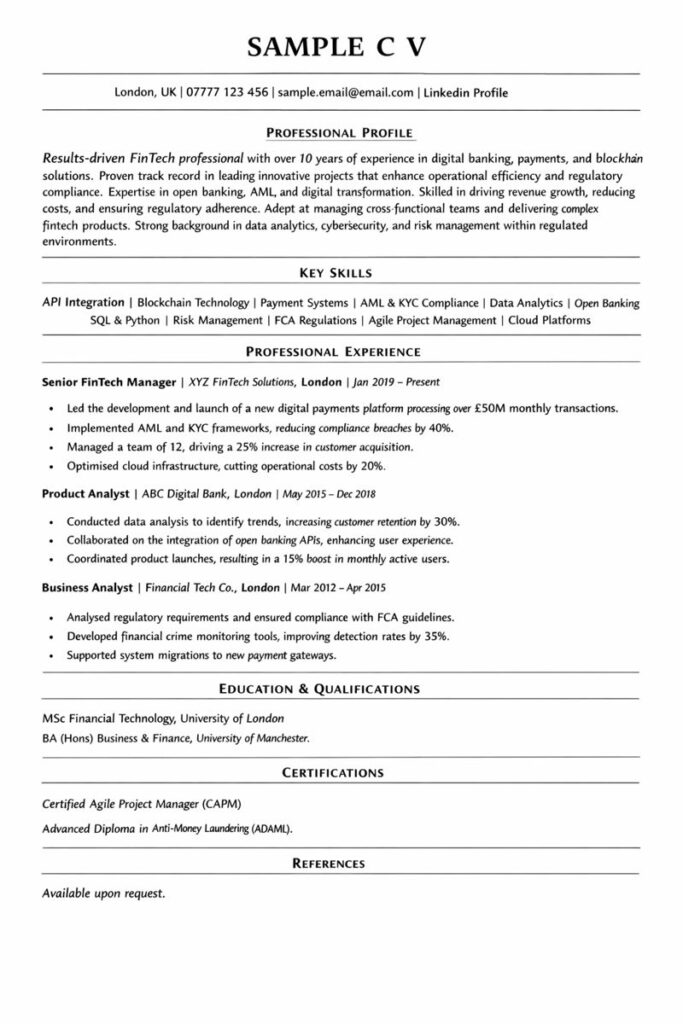
Open your CV with a concise professional profile of three to four lines. This is your pitch. State your role, years of experience, core FinTech specialism and the value you bring. For example, mention payments, open banking, blockchain, data analytics, cybersecurity or financial crime, alongside outcomes such as revenue growth, cost reduction or compliance improvement. This section is vital for applicant tracking systems and for busy recruiters scanning hundreds of CVs.
Structure matters in a FinTech CV. Use a clean, modern layout with clear sections for profile, key skills, professional experience, education and certifications. In the UK market, two pages is the sweet spot for most FinTech professionals. Avoid clutter and jargon overload. White space improves readability and ensures your CV looks credible and professional, particularly when applying to regulated financial institutions.
Your key skills section should be tailored for each application. This is where you align your experience with the FinTech job description. Include a mix of technical skills and commercial capabilities. Examples might include API integration, cloud platforms, SQL, Python, risk management, AML, PSD2, FCA regulation, product management and stakeholder engagement. These keywords help your FinTech CV perform well with ATS software while also reassuring human readers that you understand the sector.
When writing your professional experience, focus on achievements rather than responsibilities. I always encourage clients to use a results-led approach. Start each bullet point with an action verb and follow with measurable impact. For instance, instead of saying you “worked on a payments platform”, explain that you “led the delivery of a payments platform processing £20m monthly transactions, reducing settlement time by 30 percent”. This style instantly elevates your FinTech CV and demonstrates commercial awareness.
Quantification is particularly powerful in digital finance and FinTech roles. Numbers bring credibility. Include metrics such as transaction volumes, user growth, cost savings, regulatory audit outcomes or system uptime improvements. If exact figures are confidential, use percentages or ranges. This approach reassures employers that you can deliver results in fast-paced, data-driven environments.
Education and certifications should support your story, not dominate it. List relevant degrees and professional qualifications such as computer science, finance, economics or business. If you hold FinTech-relevant certifications, such as agile, product management, cloud or compliance training, include them clearly. Continuous learning is highly valued in FinTech careers, so showing recent development strengthens your CV.
Don’t forget the importance of tailoring. A FinTech CV is never one-size-fits-all. Adjust your profile, skills and achievements for each role, whether it’s a product manager in a challenger bank or a data analyst in a regtech firm. This tailored approach significantly improves interview conversion rates and reinforces your personal brand.
Finally, remember that your CV and LinkedIn profile must work together. Recruiters routinely cross-check both. Consistency in messaging, keywords and achievements boosts trust and visibility. A strong FinTech resume UK employers respond to is clear, confident and focused on value.
FinTech CV Sample
If you want your FinTech CV and LinkedIn profile to truly stand out, I’d be delighted to help. Book an appointment with me, Jerry Frempong, or one of CVLondon’s expert CV writers, and let’s position you for the opportunities you deserve in the FinTech sector. Visit https://www.cvlondon.net/book-an-appointment/ and take the next confident step in your career today.