
how to write an actuarial cv that truly opens doors
After more than 25 years as a UK-based career coach, I can confidently say that actuarial professionals sit among the most commercially valuable and intellectually respected candidates in the market. Yet many actuarial CVs fail to reflect this. Writing an effective actuarial CV is not about listing exams and technical tools alone; it is about demonstrating business impact, analytical judgement and professional credibility in a way recruiters immediately trust.
An actuarial CV should feel precise, confident and purposeful, just like the profession itself. Recruiters scanning actuarial CVs are often senior professionals with limited time. They want clarity, relevance and evidence that you can apply actuarial thinking to real commercial problems.
understanding what employers look for in an actuarial cv
Actuarial employers look for a blend of technical expertise, commercial awareness and professional progression. Your CV must clearly communicate your actuarial exams status, modelling skills, regulatory knowledge and sector experience, whether that sits in life insurance, pensions, general insurance, reinsurance or consultancy.
Equally important is your ability to explain complex data, influence stakeholders and support business decisions. A strong actuarial CV demonstrates how your analysis improved profitability, reduced risk, supported pricing strategy or strengthened capital modelling. This is where many candidates undersell themselves.
structuring your actuarial cv for maximum impact
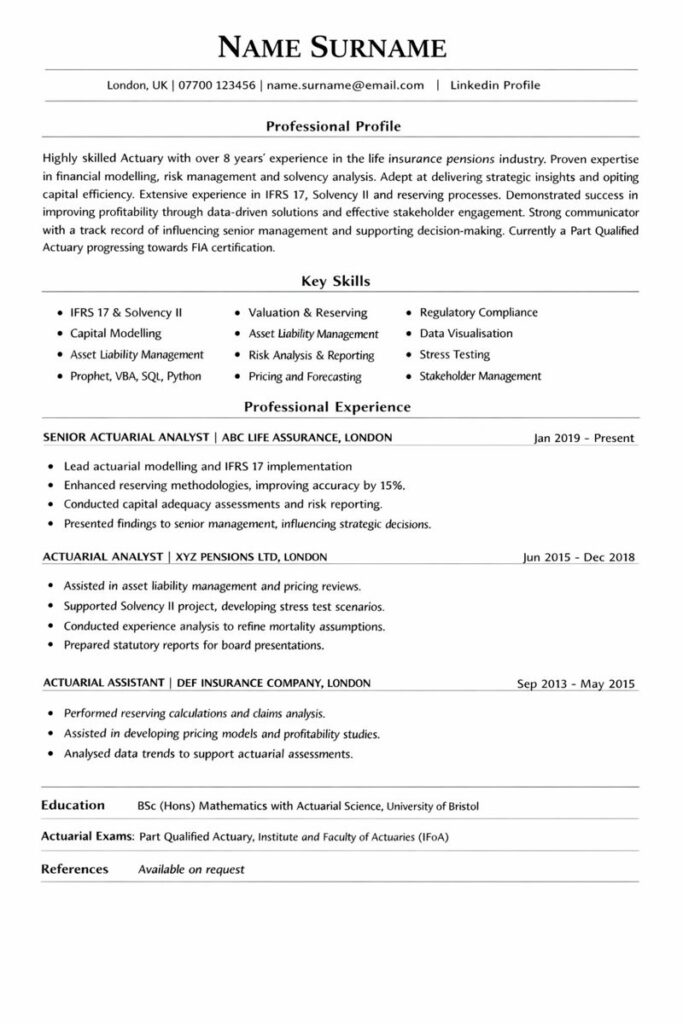
A clean, professional structure is essential. Your actuarial CV should typically be two pages in length and easy to navigate. Begin with a concise professional profile that positions you clearly as an actuarial analyst, actuarial student, nearly qualified or qualified actuary. This section should highlight your sector focus, years of experience and key strengths in actuarial modelling, risk management or financial reporting.
Follow this with a core skills section that includes actuarial software, programming languages and methodologies such as Prophet, VBA, R, Python, SQL, Solvency II, IFRS 17, capital modelling and pricing analysis. This helps your CV perform strongly for both recruiter review and applicant tracking systems.
how to present actuarial experience effectively
Your employment history should focus on outcomes, not tasks. Each role should clearly show how your actuarial work added value. Instead of saying you “supported reserving analysis”, explain how your reserving work improved accuracy, supported audits or influenced senior management decisions.
Use quantified results wherever possible. Employers respond positively to actuarial CVs that demonstrate measurable impact such as cost savings, efficiency gains, improved risk metrics or enhanced pricing models. This approach strengthens your credibility and positions you as commercially minded rather than purely technical.
highlighting actuarial exams and qualifications
Actuarial exams are important, but they should be presented strategically. Clearly state your professional body, exam progress and expected qualification date if applicable. Avoid listing every exam module in excessive detail. Recruiters want to see momentum and commitment, not clutter.
If you are a student actuary, balance exam progress with practical application. If you are qualified, focus more heavily on leadership, mentoring and strategic contribution rather than technical learning alone.
tailoring your actuarial cv for the uk market
The UK actuarial market is competitive and sophisticated. Your CV must reflect familiarity with UK regulatory frameworks, market practices and employer expectations. Language should be professional, confident and clear, avoiding overly academic phrasing.
Tailoring your actuarial CV for each role significantly improves interview success. Adjust your professional summary and experience emphasis depending on whether the role is pricing, reserving, capital, risk or consultancy focused. A targeted actuarial CV always outperforms a generic one.
common actuarial cv mistakes to avoid
One of the most common mistakes I see is excessive technical jargon with little context. Another is underplaying achievements or assuming the reader understands your impact without explanation. Poor formatting, long paragraphs and vague responsibilities can also weaken even very strong actuarial profiles.
Your actuarial CV should feel like a well-constructed business case for hiring you. Every line should earn its place.
final thoughts and next steps
Writing a compelling actuarial CV is an investment in your career progression. Done well, it positions you as credible, confident and commercially valuable. Done poorly, it can quietly block opportunities you deserve.
Actuarial CV Sample
If you would like expert support, I would be delighted to help. I invite you to book an appointment to have your CV and LinkedIn profile professionally reviewed and improved, either with me, Jerry Frempong, or one of CVLondon’s expert CV writers. We understand the actuarial market and know how to present your experience in a way that gets results.
Book your appointment today at
https://www.cvlondon.net/book-an-appointment/