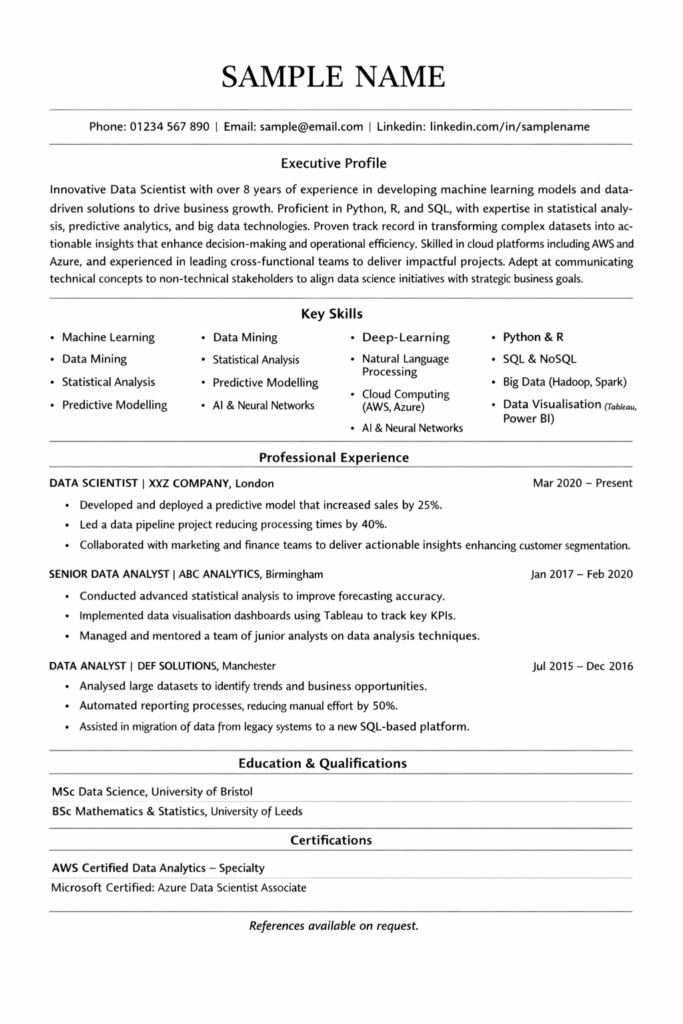
How to write a compelling Data Science CV that wins interviews
After more than twenty five years as a UK based career coach and professional CV writer, I can tell you with complete confidence that a strong Data Science CV is never just a list of technical skills. It is a strategic marketing document that positions you as a commercially aware problem solver who delivers measurable results through data driven insight.
The field of data science is competitive and fast moving. Employers are searching for candidates with expertise in machine learning, data analysis, Python, SQL, artificial intelligence, big data, data visualisation, statistical modelling and predictive analytics. Your CV must not only demonstrate these capabilities but also show how you have applied them to create business impact.
Start with a powerful personal profile
Your professional profile sits at the top of your CV and should immediately communicate your value. In three to four concise sentences, outline your years of experience in data science, your key technical strengths and the industries you have supported. Mention your proficiency in tools such as Python, R, SQL, Power BI, Tableau, TensorFlow or cloud platforms like AWS and Azure if relevant.
Most importantly, position yourself as someone who translates complex data into actionable insight. Hiring managers want data scientists who understand business objectives, not just algorithms.
Showcase your core skills clearly
A well structured key skills section helps your CV perform strongly in applicant tracking systems and reassures recruiters that you meet the technical criteria. Include essential SEO keywords such as machine learning, data mining, data modelling, data engineering, data warehousing, deep learning, natural language processing, data governance and business intelligence.
Avoid simply listing tools. Group your skills into categories such as programming languages, analytics tools, cloud technologies and methodologies. This creates clarity and demonstrates depth of knowledge.
Focus on achievements not responsibilities
This is where many data science professionals fall short. Employers are not interested in a job description. They want evidence of impact.
Under each role, briefly describe the organisation and your remit, then concentrate on quantifiable achievements. For example, explain how you built a predictive analytics model that increased revenue by a certain percentage, reduced operational costs, improved customer retention or enhanced forecasting accuracy.
Use figures wherever possible. Percentages, time savings, revenue growth and efficiency improvements strengthen credibility. Statements such as improved reporting process are weak. Instead say designed automated reporting solution using Python and SQL that reduced manual processing time by forty percent.
Highlight collaboration and communication
Data science does not operate in isolation. Demonstrate your ability to work cross functionally with stakeholders in marketing, finance, operations or product teams. Show that you can present complex insights in a clear and engaging way to non technical audiences.
If you have led projects, mentored junior analysts or influenced strategic decisions through data driven recommendations, make that visible. Leadership and stakeholder management are highly valued in senior data scientist and head of data roles.
Include relevant projects
If you are an early career data scientist or career changer, a dedicated projects section is extremely valuable. Outline academic research, portfolio projects or Kaggle competitions. Describe the problem, the data sets used, the methodologies applied and the results achieved.
Employers want practical application. Even a self initiated machine learning project that demonstrates real world problem solving can strengthen your Data Science CV significantly.
Education and professional development
List your degree in data science, computer science, mathematics, statistics or a related discipline. If you hold a masters degree or PhD, ensure this is clearly presented. Include certifications such as AWS Certified Data Analytics, Microsoft Certified Data Scientist or relevant courses in artificial intelligence and big data.
Continuous learning is vital in this sector. Showing recent training demonstrates that you remain current in a rapidly evolving industry.
Optimise for applicant tracking systems
Many employers use automated screening software. To improve your visibility, ensure that key phrases such as data science CV, machine learning engineer, data analytics, big data solutions, statistical analysis and data visualisation appear naturally within your content.
Avoid graphics and complex formatting. A clean, professional layout ensures your CV is readable by both systems and humans.
Keep it concise and focused
In the UK market, two pages are typically sufficient even for experienced professionals. Be selective. Every line must add value and reinforce your positioning as a high performing data science professional.
Above all, remember that your CV is your personal marketing brochure. It should confidently articulate who you are, what you do and the measurable results you deliver.
If you would like expert support to transform your Data Science CV into a compelling interview winning document, I would be delighted to help. At CVLondon, my team and I specialise in crafting powerful CVs and optimising LinkedIn profiles that attract recruiters and hiring managers across the UK and internationally.
Book a personalised consultation today and take the next step towards securing your ideal data science role. You can arrange an appointment with me, Jerry Frempong, or one of our expert CV writers here https://www.cvlondon.net/book-an-appointment/. I look forward to helping you present the very best version of your professional story.
Data Science CV Sample