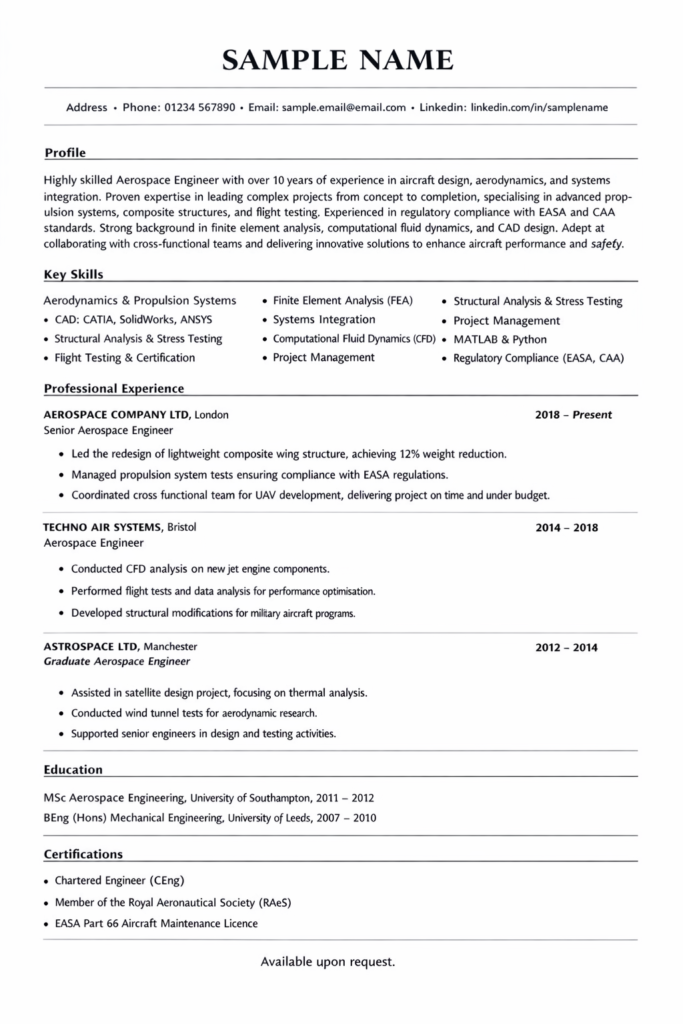
Writing an outstanding Aerospace Engineering CV is one of the most important steps in securing your next role in this competitive and highly technical sector. After more than twenty five years as a UK based career coach, I have worked with aerospace engineers at every level, from ambitious graduates to senior project leaders working on advanced aircraft systems. The difference between a good CV and a truly compelling Aerospace Engineering CV often determines who gets invited to interview.
Your CV must immediately communicate technical excellence, commercial awareness, and measurable impact. Recruiters and hiring managers in aerospace engineering are looking for precision, clarity, and evidence of results. They want to see that you can design, analyse, test, and deliver complex aerospace systems within strict regulatory frameworks.
Start with a strong professional profile. This is your opening statement and should position you clearly within aerospace engineering. Include key phrases such as Aerospace Engineer, aerodynamics, propulsion systems, structural analysis, CAD design, systems integration, and regulatory compliance. If you are applying within the UK, reference standards such as EASA or CAA where relevant. This short paragraph should summarise your years of experience, your technical specialism, and the value you bring to an aerospace organisation.
Next, focus on your core competencies. This section should highlight both technical and soft skills. Include software tools such as CATIA, SolidWorks, MATLAB, ANSYS, and Python if applicable. Mention finite element analysis, computational fluid dynamics, flight testing, stress analysis, and project management. Many employers use ATS systems to screen applications, so including relevant aerospace engineering keywords is essential for your CV to be shortlisted.
When detailing your professional experience, avoid simply listing responsibilities. Instead, demonstrate achievement. For example, rather than stating that you were responsible for wing design, explain that you led the redesign of a composite wing structure that reduced weight by ten percent while maintaining structural integrity and meeting regulatory requirements. Quantifiable results transform your Aerospace Engineer CV from average to exceptional.
Structure each role clearly. Include your job title, employer, location, and dates of employment. Under each position, use concise paragraphs to outline major projects, design contributions, testing activities, cross functional collaboration, and leadership responsibilities. Aerospace engineering is rarely a solo effort, so emphasise teamwork, stakeholder engagement, and communication with suppliers or regulatory bodies.
Education is particularly important in aerospace engineering. Clearly list your degree in Aerospace Engineering or related discipline, the university attended, and your classification. If you completed a Masters degree or PhD in aeronautics, astronautics, or mechanical engineering, showcase this prominently. Professional memberships such as the Royal Aeronautical Society or progress toward Chartered Engineer status should also be included, as they demonstrate credibility and commitment to professional development.
For early career professionals, internships, industrial placements, and final year projects can significantly strengthen your Aerospace Engineering CV. Describe your dissertation topic, laboratory research, wind tunnel testing, or satellite design projects. Employers value practical exposure and applied knowledge.
A well designed CV template for aerospace engineering should be clean, professional, and logically structured. Avoid overly creative layouts. This industry values clarity and precision. Use consistent formatting, clear headings, and professional language. Keep your CV to two pages if you are early to mid career. Senior professionals may extend slightly beyond this if necessary, but always remain concise.
Do not overlook the importance of tailoring your CV for each application. If the role focuses on propulsion systems, bring relevant propulsion experience to the forefront. If it is centred on defence aerospace, highlight security clearance, defence contracts, or experience with military specifications. Customisation dramatically increases your interview success rate.
In today’s market, your LinkedIn profile must align with your Aerospace Engineering CV. Recruiters routinely search LinkedIn for aerospace engineers using keywords such as aircraft design engineer, avionics engineer, systems engineer aerospace, and space systems engineer. Ensure your headline, summary, and project descriptions mirror the strength of your CV. Consistency builds credibility.
Finally, pay attention to presentation. Aerospace engineering is about accuracy and attention to detail. Spelling mistakes or inconsistent formatting can undermine your application. Proofread carefully and consider professional CV writing support if you are unsure.
Your Aerospace Engineering CV is more than a document. It is your professional engineering story. It should reflect innovation, technical excellence, and measurable impact. With the right structure, strong keywords, and achievement focused language, you will stand out in a competitive aerospace job market.
If you are serious about advancing your aerospace engineering career, do not leave your CV and LinkedIn profile to chance. I have helped thousands of professionals across the UK secure interviews with leading aerospace employers. Book a personalised consultation today and let us position you for success.
Visit https://www.cvlondon.net/book-an-appointment/ to book an appointment with me, Jerry Frempong, or one of CVLondon’s expert CV writers. Your next aerospace opportunity could be one expertly written CV away.
Aerospace Engineering CV Sample