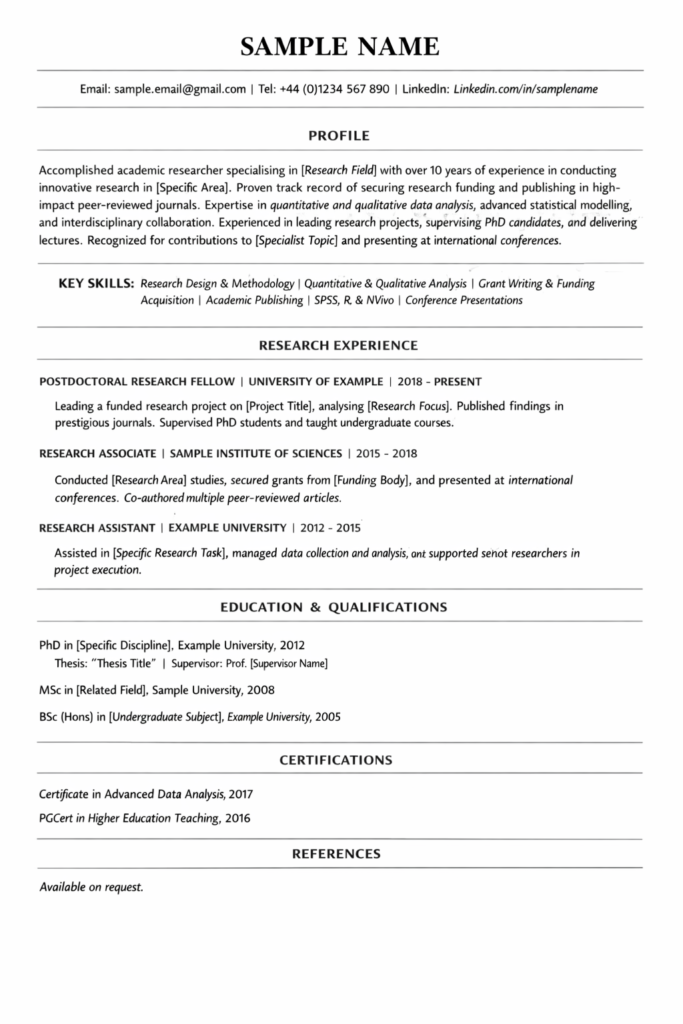
Creating a compelling Academic Research CV is one of the most important steps you will take in building a successful career within academia. After more than 25 years as a UK based career coach supporting researchers, lecturers and postdoctoral fellows, I can confidently say that a well structured academic CV opens doors to university applications, research funding and international collaborations.
An Academic Research CV is very different from a standard corporate CV. It must showcase intellectual depth, evidence of impact, and a clear trajectory of scholarly development. Whether you are preparing a research assistant CV, a postdoctoral CV or applying for a lectureship, your document must communicate credibility, authority and academic potential.
Start with a clear professional profile. This short paragraph at the top of your Academic Research CV should summarise your research specialism, years of experience, key methodologies and academic focus. Include strong SEO relevant keywords naturally within your writing such as academic research, data analysis, quantitative research, qualitative research, grant funding and peer reviewed journals. This section should immediately position you as a serious academic candidate aligned with academia jobs in the UK or internationally.
Next, detail your research interests. Universities and research institutions want alignment. Be precise about your subject area and demonstrate intellectual coherence. A strong research CV example will clearly articulate core themes, theoretical frameworks and methodologies. If you work with advanced statistical modelling, laboratory experimentation, archival analysis or interdisciplinary collaboration, state this confidently.
Education follows, but in academic CV writing this section carries more weight than in most industries. List your PhD, Masters and relevant degrees in reverse chronological order. Include thesis titles and supervisors if appropriate, particularly for early career researchers. For university applications in the UK, clarity and academic rigour are vital.
Publications are the backbone of an Academic Research CV. Separate peer reviewed journal articles, book chapters, conference proceedings and manuscripts under review. Where possible, mention impact factor, citation metrics or journal rankings to demonstrate influence. If you have secured publication in respected peer reviewed journals, ensure they are prominently positioned. This is a crucial element of any strong academic CV UK format.
Research funding and grants deserve their own section. Detail funding body, project title, amount awarded and your role within the project. Whether you have been principal investigator or co investigator, universities are looking for evidence that you can attract funding. Strong grant writing and successful funding applications are powerful differentiators in competitive academia jobs.
Teaching experience should also be clearly presented. Even research intensive roles expect some contribution to teaching and supervision. Include module titles, level taught, curriculum development and student supervision. If you have supervised dissertations or PhD candidates, this adds significant weight to your research assistant CV or postdoctoral CV.
Conference presentations and invited talks demonstrate academic engagement. List keynote speeches, panel participation and international conferences. This shows visibility within your research community. Academic recruitment panels want to see that you contribute actively to scholarly dialogue.
Do not overlook professional affiliations and memberships. Being part of recognised academic societies strengthens your profile and signals commitment to your discipline. If you serve as a peer reviewer for journals or sit on editorial boards, include this. It reinforces authority.
Skills in an Academic Research CV should focus on methodology, data analysis software, laboratory techniques or specialist tools. Examples may include SPSS, R, Python, NVivo, GIS mapping or advanced laboratory instrumentation. Avoid generic statements. Specificity builds credibility.
Formatting matters. An academic CV template should be clean, well structured and easy to navigate. Use consistent headings, logical sequencing and professional language. Unlike corporate CVs, an Academic Research CV can be longer than two pages, particularly for experienced academics. However, it must remain focused and relevant.
Increasingly, your LinkedIn profile plays a supporting role in academic visibility. Ensure your LinkedIn profile optimisation aligns with your Academic Research CV. Use consistent research keywords, highlight publications and engage with academic networks. Universities and funding bodies often review online presence as part of due diligence.
Above all, your tone should reflect confidence grounded in evidence. Do not undersell your achievements. Academia values measurable contribution, intellectual independence and collaboration. Your Academic Research CV is your scholarly narrative. It should show progression from doctoral research to independent funding and publication impact.
If you are unsure whether your research CV example truly reflects your potential, that is where professional guidance can make all the difference. A strategically written Academic Research CV can transform your university applications and significantly increase interview success rates.
I would be delighted to help you present your academic achievements at the highest possible standard. Book an appointment with me, Jerry Frempong, or one of CVLondon expert CV writers, and let us refine your Academic Research CV and LinkedIn profile into a powerful career advancing document.
Secure your consultation today at https://www.cvlondon.net/book-an-appointment/ and take the next confident step in your academic journey.
Academic Research CV Sample