Writing a compelling Biotechnology CV
As a career coach with over twenty five years of experience supporting professionals across the UK and internationally, I can assure you that writing a strong Biotechnology CV is both a science and an art. The biotechnology sector is one of the most innovative and fast growing industries in the world. Employers are searching for candidates who combine technical expertise, commercial awareness and the ability to translate research into real world impact. Your CV must reflect exactly that.
A Biotechnology CV is not simply a list of laboratory techniques and academic achievements. It is a strategic marketing document designed to position you as a valuable asset within biotechnology, pharmaceutical, life sciences, clinical research or medical device organisations. Whether you are applying for roles in research and development, regulatory affairs, quality assurance, bioinformatics or bioprocess engineering, your CV must demonstrate measurable results and specialist knowledge.
Start with a powerful professional profile
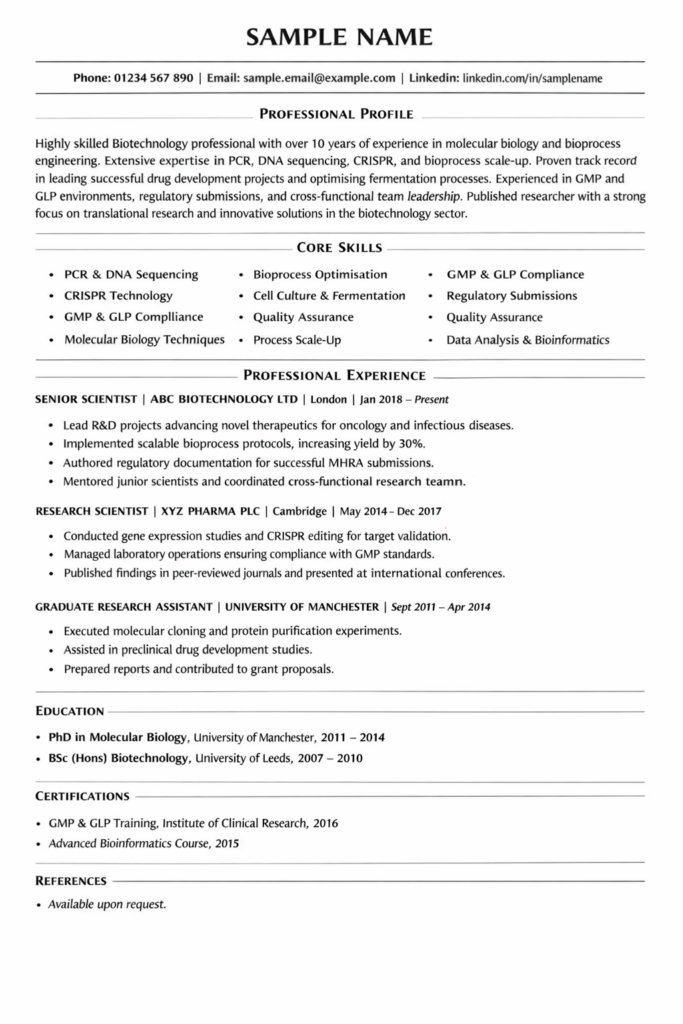
Your professional profile should sit at the top of your CV and immediately communicate your specialism within biotechnology. In three to four concise paragraphs, outline your years of experience, core technical competencies and sector focus. Use relevant SEO keywords such as biotechnology professional, molecular biology, drug development, clinical trials, GMP compliance, laboratory research, regulatory standards and data analysis.
For example, if you are a molecular biologist, highlight your expertise in PCR, cell culture, DNA sequencing or CRISPR technologies. If your background is in bioprocess engineering, reference upstream and downstream processing, fermentation, scale up and validation. Recruiters and applicant tracking systems actively scan for these keywords, so including them naturally within your profile is essential.
Showcase technical and laboratory skills clearly
A dedicated technical skills section is vital for any Biotechnology CV. This should be structured and easy to scan. Include laboratory techniques, analytical instrumentation, bioinformatics tools, regulatory knowledge and software competencies. Mention specific platforms such as chromatography systems, flow cytometry, ELISA, mass spectrometry or statistical software.
Employers in the biotechnology and pharmaceutical sectors value precision. Therefore, be specific rather than general. Instead of writing experienced in laboratory work, state conducted gene expression analysis using quantitative PCR across fifty clinical samples, improving assay sensitivity by twenty percent.
Demonstrate commercial impact and research outcomes
One common mistake I see is candidates focusing solely on academic responsibilities. The biotechnology industry is commercially driven. Hiring managers want to understand how your work contributed to product development, cost reduction, process optimisation or successful regulatory submission.
Quantify achievements wherever possible. Did you contribute to a successful IND application. Did your research support progression from preclinical to phase one clinical trials. Did you reduce production downtime or increase yield in a biomanufacturing environment. These outcomes demonstrate value and differentiate you from other applicants.
If you have published research, include selected publications, patents or conference presentations. This strengthens your credibility and positions you as an expert within your scientific niche.
Highlight regulatory and compliance expertise
Biotechnology employers operate within strict regulatory frameworks. Experience with GMP GLP GCP MHRA or EMA standards is highly sought after. If you have been involved in audits, validation processes, documentation control or quality management systems, ensure this is clearly articulated.
For professionals targeting regulatory affairs or quality assurance roles, emphasise your knowledge of regulatory submissions, dossier preparation, risk assessments and compliance monitoring. These keywords are frequently searched within biotechnology recruitment.
Present education and professional development strategically
The biotechnology sector is academically rigorous. List your degrees in reverse chronological order, including your MSc, PhD or BSc in Biotechnology, Molecular Biology, Biochemistry or related life sciences disciplines. If your research project is directly relevant to the role you are applying for, briefly describe its focus and outcomes.
Continuous professional development is also important. Include relevant certifications, laboratory training, data analysis courses or leadership programmes. This signals to employers that you remain current within an evolving scientific landscape.
Tailor your Biotechnology CV for each application
No two biotechnology roles are identical. Carefully analyse the job description and mirror the language used by the employer. If the advert emphasises biostatistics, translational research or vaccine development, ensure those terms appear within your CV where applicable. This alignment improves your chances of passing applicant tracking systems and reaching the interview stage.
Keep formatting clean and professional
A Biotechnology CV should be clear, well structured and typically two pages in length for most professionals. Use logical headings, consistent spacing and professional language. Avoid excessive graphics or overly complex formatting. The focus must remain on your scientific expertise and achievements.
Be confident and forward thinking
The biotechnology industry is shaping the future of healthcare, sustainability and global wellbeing. Your CV should convey not only competence but enthusiasm for innovation and scientific advancement. Employers are drawn to candidates who demonstrate curiosity, collaboration and leadership potential.
If you are transitioning from academia to industry, emphasise transferable skills such as project management, cross functional collaboration, grant writing and stakeholder engagement. These competencies are highly valued within commercial biotechnology environments.
Take the next step in your biotechnology career
Writing an exceptional Biotechnology CV requires clarity, strategy and a deep understanding of what biotechnology employers truly seek. If you would like expert guidance to refine your CV, optimise your LinkedIn profile and position yourself competitively within the biotechnology and life sciences sector, I would be delighted to support you.
Book a personal consultation with me Jerry Frempong or one of CVLondon’s expert CV writers today and take confident steps towards securing your next biotechnology role. Visit https://www.cvlondon.net/book-an-appointment/ to schedule your appointment. Your future in biotechnology deserves a CV that opens doors.
Biotechnology CV Sample