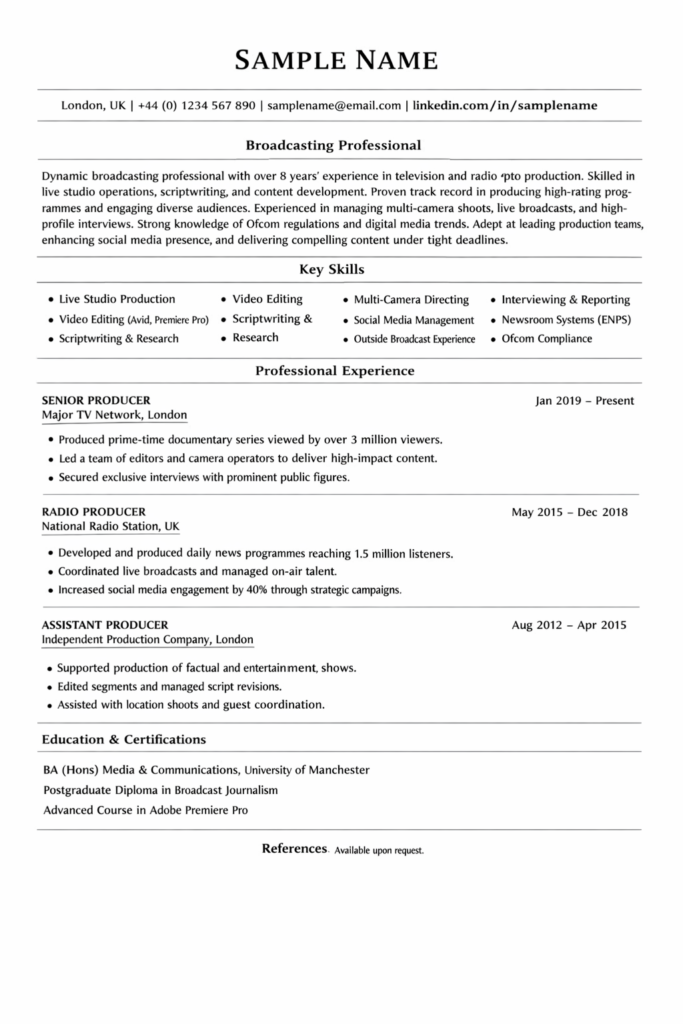
Writing a compelling Broadcasting CV is about far more than listing programmes you have worked on. It is about presenting your story with clarity, confidence and commercial awareness. After more than 25 years as a UK based career coach, I can assure you that the strongest Broadcasting CV is one that demonstrates impact, creativity and professionalism in equal measure.
The broadcasting industry is competitive, whether you are targeting television, radio, digital media or podcasting. Your CV must immediately communicate your niche. Are you a presenter, producer, broadcast journalist, production assistant, editor or sound engineer. A focused headline such as Broadcasting Professional specialising in Live Television Production or Radio Presenter and Content Creator for National Networks helps recruiters quickly understand where you fit.
Your professional profile is the heartbeat of your Broadcasting CV. In three to five lines, summarise your experience, technical strengths and career highlights. Use strong SEO keywords naturally within this section such as Broadcasting CV, media professional, television production, radio broadcasting, journalism, live studio, post production and UK broadcasting jobs. This ensures your CV performs well when uploaded to job boards and searched by recruiters.
For example, you might write that you are an experienced broadcasting professional with eight years in television and radio production, skilled in live studio coordination, script writing and audience engagement, with a proven record of increasing listener figures or viewer ratings. Specific achievements build credibility instantly.
When detailing your work experience, always focus on results rather than responsibilities. Many candidates write generic statements such as responsible for editing footage or assisted with show production. Instead, quantify your contribution. Did you help deliver a prime time programme viewed by two million people. Did you reduce production costs. Did you secure high profile interviewees. Did you improve social media engagement linked to broadcasts.
Each role should include your job title, organisation, location and dates, followed by concise bullet points outlining achievements. This approach works equally well for a television CV, radio CV or production CV. Broadcasting employers value measurable impact, teamwork and the ability to perform under pressure.
Technical skills are crucial in any Broadcasting CV template. List relevant software, equipment and platforms such as Adobe Premiere Pro, Avid, Final Cut Pro, audio mixing desks, newsroom systems and digital content management tools. If you have experience with live outside broadcasts, compliance with Ofcom regulations or multi camera directing, make this clear. These specific keywords enhance both human and applicant tracking system searches.
For those pursuing presenter CV roles, highlight voice training, live presenting experience, audience demographics and brand collaborations. If you are a broadcast journalist, emphasise investigative research, script development, interviewing skills and breaking news coverage. Tailoring your CV to your chosen pathway is one of the most powerful strategies I recommend.
Education and professional development should support your expertise. Include degrees in media production, journalism or communications, alongside relevant workshops, short courses or certifications. Continuous learning demonstrates commitment in a fast evolving industry shaped by digital innovation and streaming platforms.
Do not overlook the importance of personal branding. In today’s broadcasting landscape, your LinkedIn profile and showreel are extensions of your CV. Include a link to your professional portfolio or online reel. Ensure consistency in messaging across your CV and digital presence. Recruiters often review both before making interview decisions.
Clarity and presentation matter enormously. Keep your Broadcasting CV to two pages. Use a clean, modern layout with clear section headings and consistent formatting. Avoid dense paragraphs. White space improves readability and ensures key achievements stand out. Your CV should feel as polished as a well produced broadcast.
Another common question I hear is how to stand out when competing for UK broadcasting jobs with the BBC, independent production companies or commercial radio stations. The answer lies in storytelling. Broadcasting is about connecting with audiences. Your CV should reflect your ability to tell compelling stories, solve problems creatively and collaborate effectively.
Voluntary projects, community radio, student productions and freelance assignments are all valuable. Early career professionals often underestimate the power of these experiences. If they demonstrate initiative, technical skill or audience growth, they absolutely deserve space on your CV.
Finally, remember confidence is key. A Broadcasting CV example that reads with energy and pride signals that you understand your value. Avoid apologetic language. Instead of saying I had the opportunity to assist, say I contributed to the successful delivery of a live national broadcast. Own your achievements.
If you would like expert guidance tailored to your career stage, I warmly invite you to take the next step. A professionally written Broadcasting CV can transform your prospects and position you strongly within the media sector. Let us refine your CV, strengthen your LinkedIn profile and ensure your personal brand reflects the talented broadcasting professional you truly are.
Book an appointment today with me Jerry Frempong or one of CVLondon’s expert CV writers and take control of your broadcasting career with confidence https://www.cvlondon.net/book-an-appointment/. Your next role in television, radio or digital media could be closer than you think.
Broadcasting CV Sample