Commercial banking sits at the heart of the UK economy. From supporting SMEs and large corporates to managing credit risk and driving sustainable growth, commercial bankers play a pivotal role in ensuring businesses can operate, expand and innovate. As a commercial banker, you are trusted with client relationships, lending decisions, financial analysis, regulatory compliance and revenue generation. It is a role that combines financial acumen with relationship management, strategic thinking and commercial awareness.
Typical job responsibilities in commercial banking include managing a portfolio of business clients, assessing creditworthiness, structuring lending solutions, monitoring risk exposure, cross-selling financial products, and working closely with internal stakeholders such as credit, risk, legal and compliance teams. Senior roles often extend into leadership, portfolio strategy, people management and contribution to regional or national growth targets.
In the UK, salaries in commercial banking remain highly competitive. Entry-level and graduate commercial banking roles often start between £30,000 and £40,000, while experienced relationship managers and associates typically earn between £50,000 and £80,000. Senior commercial bankers, directors and heads of commercial banking can command salaries well into six figures, particularly when bonuses and incentives are included. With such strong earning potential and long-term career security, competition for these roles is intense, making a strong, interview-winning commercial banking CV absolutely essential.
Why a commercial banking CV must be strategically written
After more than 25 years as a UK-based career coach, I can confidently say that most commercial banking CVs fail not because candidates lack experience, but because their CVs do not communicate value in the language hiring managers understand. Commercial banking recruiters look for evidence of revenue generation, risk management, client retention, portfolio growth and regulatory awareness. A generic CV simply listing duties will not get you shortlisted.
An interview-winning commercial banking CV template example is not about copying wording from job descriptions. It is about translating your experience into measurable commercial outcomes, aligning your achievements with the bank’s strategic priorities, and presenting your profile in a clear, professional and persuasive format that passes both applicant tracking systems and human review.
Understanding what banks look for in a commercial banking CV
Banks recruit commercial bankers who can demonstrate trust, competence and consistency. When reviewing CVs, hiring managers typically scan for a few critical elements within seconds. These include relevant banking experience, scale of portfolios managed, client types served, credit exposure, lending authority, revenue impact and compliance knowledge.
Your CV should clearly answer the following questions without forcing the reader to dig. What type of clients have you managed? What size of portfolios have you handled? How did you contribute to growth, profitability and risk control? How senior are you, and what decisions were you trusted to make?
A high-ranking commercial banking CV must also reflect the culture of banking. This means precision, professionalism, clarity and accountability. Sloppy formatting, vague language or exaggerated claims can be immediate red flags.
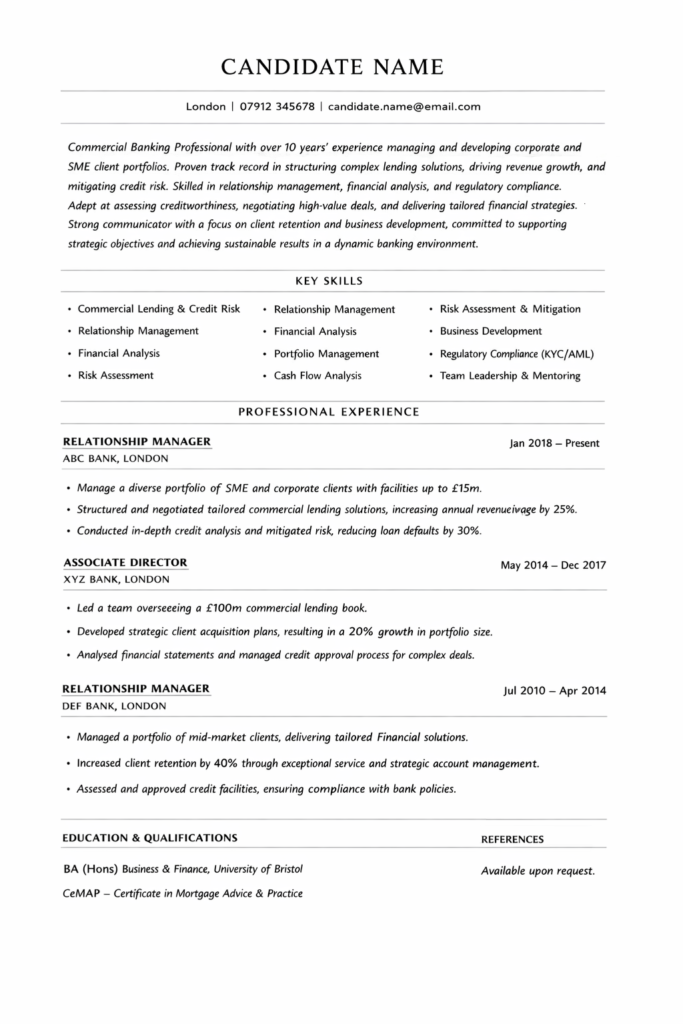
Commercial banking CV template example explained section by section
Personal profile summary
Your personal profile is one of the most important sections of your commercial banking CV. In three to five lines, you should position yourself clearly within commercial banking, stating your level of experience, sector focus and key strengths. This is not a career objective. It is a professional summary that sells your value.
For example, an effective profile might reference your years of experience in commercial banking, the types of businesses you support, your expertise in credit analysis, relationship management or portfolio growth, and your ability to deliver sustainable revenue while managing risk.
Key skills and competencies for commercial banking
This section should be tailored to commercial banking keywords and structured in a clean, scannable format. Skills commonly expected include commercial lending, credit risk assessment, financial analysis, relationship management, portfolio management, regulatory compliance, KYC and AML, stakeholder engagement and sales performance.
Avoid generic soft skills without context. Banks expect evidence-based capability, so these skills should be reinforced later through achievements in your career history.
Professional experience in commercial banking
Your career history is where your CV either wins or loses interviews. Each role should be clearly structured with your job title, employer, location and dates. Beneath this, focus on achievements rather than responsibilities.
Strong commercial banking CVs quantify impact wherever possible. This might include portfolio size, lending volumes, growth percentages, revenue generated, reduction in arrears, client retention rates or successful complex deals closed. Even in regulated environments, there are always metrics that demonstrate performance.
Use language that reflects commercial outcomes, such as increased lending, improved risk profile, enhanced client satisfaction or contribution to regional targets. This signals that you understand the business of banking, not just the process.
Education and professional qualifications
Commercial banking employers value strong academic foundations, particularly in finance, economics, business or related disciplines. Degrees should be clearly listed along with institutions and dates. Professional qualifications such as CeMAP, CFA, ACCA modules, credit risk certifications or internal banking accreditations should also be included.
For experienced professionals, education should support your profile rather than dominate it. For graduates, it can play a more prominent role, particularly if supported by relevant modules, projects or placements.
Achievements and additional information
Optional sections such as key achievements, leadership experience, community involvement or professional memberships can further strengthen your commercial banking CV. These sections should always add relevance and credibility rather than filler content.
Optimising your commercial banking CV for applicant tracking systems
Modern banks rely heavily on applicant tracking systems to filter CVs before human review. This means your commercial banking CV must include relevant keywords naturally throughout the document. Terms such as commercial banking, relationship management, credit analysis, lending, portfolio management and regulatory compliance should appear organically in context.
Avoid over-stuffing keywords, which can read unnaturally. The goal is clarity and alignment, not manipulation. A well-written CV naturally contains the language of the profession.
CV structure that works for commercial banking roles
A clear and logical CV structure is essential. In most cases, a two-page CV is ideal for commercial banking professionals. Graduates may use one to two pages, while senior professionals may require two full pages to adequately capture their experience.
The recommended structure is profile summary, key skills, professional experience, education and qualifications, followed by additional relevant information. This structure allows recruiters to quickly assess suitability without confusion.
Advice for graduates seeking commercial banking roles
For graduates aiming to enter commercial banking, your CV must demonstrate potential, commercial awareness and transferable skills. Even if you lack direct banking experience, you can highlight internships, placements, part-time roles, case studies or academic projects that show financial understanding and client focus.
Graduates should emphasise analytical ability, communication skills and an understanding of business fundamentals. Tailoring your CV to commercial banking rather than generic finance roles significantly improves your chances of securing interviews.
Advice for middle management commercial bankers
At mid-career level, your CV should clearly show progression, increasing responsibility and measurable impact. Hiring managers want to see that you can manage larger portfolios, handle more complex clients and contribute strategically to growth and risk management.
Focus on leadership, mentoring junior colleagues, cross-functional collaboration and consistent performance over time. This positions you as a reliable and promotable professional within commercial banking.
Advice for senior and executive commercial banking professionals
Senior commercial bankers must present themselves as strategic leaders rather than transactional managers. Your CV should reflect influence, decision-making authority, contribution to regional or national strategy and leadership of teams or functions.
Board-level communication, regulatory accountability, major deals and long-term portfolio performance are particularly relevant at this level. The tone should remain factual, confident and commercially grounded.
Common do’s and don’ts on a commercial banking CV
Do tailor your CV for each commercial banking role and institution.
Do quantify achievements wherever possible.
Do keep formatting professional, clean and consistent.
Do use clear language aligned with banking terminology.
Do ensure your CV is error-free and well-structured.
Don’t use vague statements without evidence.
Don’t exaggerate responsibilities or results.
Don’t include irrelevant personal information.
Don’t overcrowd your CV with dense text.
Don’t rely on a generic template without customisation.
Final thoughts and encouragement
A strong commercial banking CV is not about sounding impressive. It is about communicating trust, competence and commercial value in a way that resonates with decision-makers. With the right structure, language and focus, your CV can open doors to interviews and accelerate your career in one of the UK’s most respected and rewarding sectors.
After supporting professionals for over 25 years, I know that even the most capable bankers often undersell themselves on paper. With expert guidance, your experience can be transformed into a compelling narrative that positions you exactly where you deserve to be.
If you would like a professionally written commercial banking CV and a fully optimised LinkedIn profile that attracts recruiters and hiring managers, I warmly invite you to book a confidential appointment. Together, we will refine your personal brand and give you the competitive edge needed in today’s market. Book your appointment here and take the next confident step in your banking career.
https://www.cvlondon.net/book-an-appointment/
Commercial Banking CV Sample