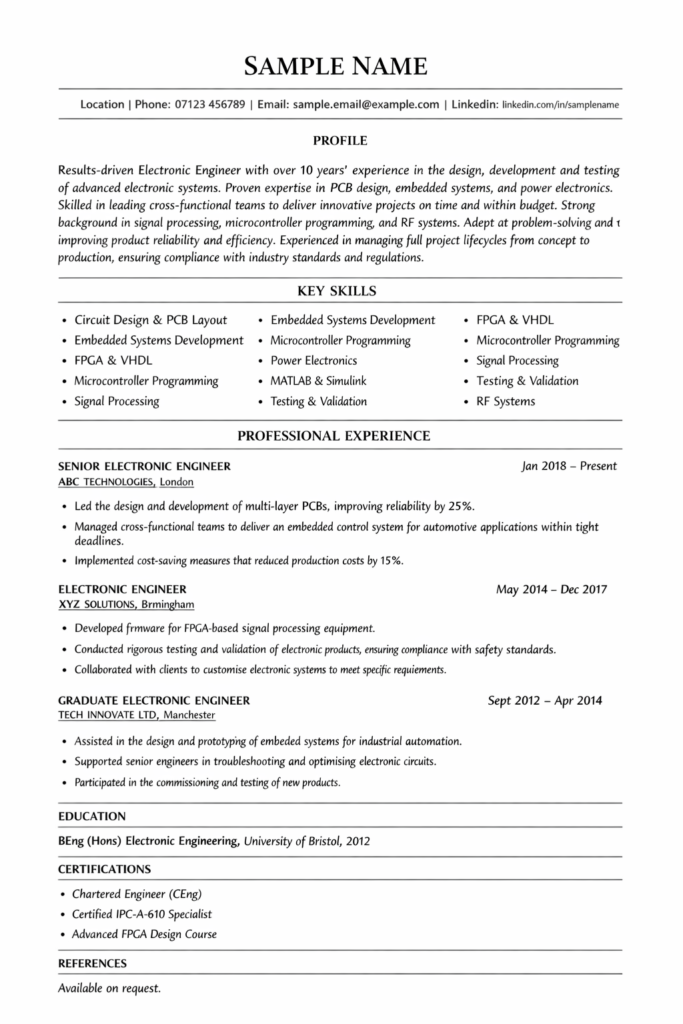
How to write a compelling Electronic Engineering CV
With over twenty five years of coaching engineering professionals across the UK, I can confidently say that a well written Electronic Engineering CV can open doors to outstanding opportunities. Whether you are a graduate electronics engineer or an experienced specialist in embedded systems or power systems, your CV must clearly communicate your technical expertise, commercial value and professional impact.
Start with a strong professional profile
Your professional profile sits at the top of your Electronic Engineering CV and acts as your personal introduction. This short paragraph should summarise your years of experience, core engineering skills, industry focus and key achievements. Recruiters in the UK typically spend only a few seconds scanning a CV initially, so clarity is essential.
Include keywords such as electronic engineering, circuit design, PCB design, embedded systems, control systems, power electronics, testing and validation, and project management where relevant. This not only positions you correctly for hiring managers but also ensures your CV performs well in applicant tracking systems, making it ATS friendly.
Highlight your core technical skills
A well structured technical skills section is vital in any Electronic Engineering CV example. Present your expertise clearly and logically. This may include:
Circuit design and simulation
PCB layout and schematic capture
Embedded C and C plus plus
MATLAB and Simulink
FPGA development
Microcontrollers and firmware development
Signal processing
Testing and validation
Compliance and safety standards
Project management and stakeholder communication
Tailor this section to each role you apply for. A power systems engineer will emphasise different capabilities compared to someone specialising in telecommunications or robotics.
Showcase your work experience with measurable impact
Your work experience section should demonstrate not just what you did, but the results you delivered. Employers hiring for UK engineering jobs want evidence of commercial awareness and problem solving ability.
Instead of stating that you were responsible for circuit design, explain that you designed and tested multi layer PCB systems that improved product reliability by twenty percent. Quantify achievements wherever possible. Mention budgets managed, timelines met, efficiency gains achieved or costs reduced.
Use clear language and avoid excessive technical jargon. While hiring managers may be technically qualified, first stage screening is often carried out by HR professionals.
Demonstrate project leadership and collaboration
Modern electronic engineering roles require collaboration across multidisciplinary teams. Highlight your involvement in cross functional projects, supplier management, client liaison and stakeholder engagement. If you have led projects from concept to production, make this clear.
Project management experience, whether formal or informal, significantly strengthens an Electronic Engineering CV. If you have worked within Agile environments or followed structured development lifecycles, include this information.
Education and professional development
Your education section should include your degree in Electronic Engineering or related discipline, university name and graduation year. If you achieved strong academic results or completed a notable dissertation, briefly reference it.
Chartered Engineer status or progress towards professional registration with a recognised engineering body can be highly advantageous. Include relevant certifications, training courses and continuous professional development activities. Employers value engineers who stay current with evolving technologies.
Include key projects
If you are early in your career or transitioning sectors, a dedicated projects section can add significant value. Detail university or industry projects that demonstrate hands on experience with hardware design, embedded systems, automation or power electronics.
Describe the objective, your role, technologies used and the outcome. This helps bring your technical capability to life and provides talking points for interviews.
Optimise for keywords and structure
An effective Electronic Engineering CV template should be clean, professional and easy to read. Use clear headings and consistent formatting. Keep your CV to two pages where possible.
Integrate relevant SEO keywords naturally throughout the main body, including Electronic Engineering CV, Electronic Engineering CV example, engineering skills, technical skills, project management, embedded systems, circuit design and UK engineering jobs. This strengthens your visibility in online searches and recruitment databases.
Avoid generic statements. Every line should reinforce your credibility as a capable and commercially aware electronics engineer.
Final thoughts from Jerry Frempong
Writing a powerful Electronic Engineering CV is about more than listing qualifications and responsibilities. It is about presenting yourself as a solutions driven engineer who delivers measurable value. When you align your technical expertise with business impact, you dramatically increase your chances of securing interviews.
If you would like expert guidance to ensure your CV and LinkedIn profile truly reflect your potential, I would be delighted to help. Book an appointment with me or one of CVLondon expert CV writers today and let us position you for the engineering opportunities you deserve.
Electronic Engineering CV Sample