Creating a powerful Film and Television CV is about far more than listing credits. It is about telling your professional story with clarity, confidence and purpose. After more than 25 years as a UK based career coach and professional CV writer, I have seen first hand how the right CV can open doors in an industry that is competitive, fast moving and built on reputation.
Whether you are an actor, runner, production assistant, director, producer, screenwriter or working in post production, your Film and Television CV must immediately communicate your value. Casting directors, production companies and broadcast executives do not have time to decode vague information. They want impact, relevance and professionalism from the very first line.
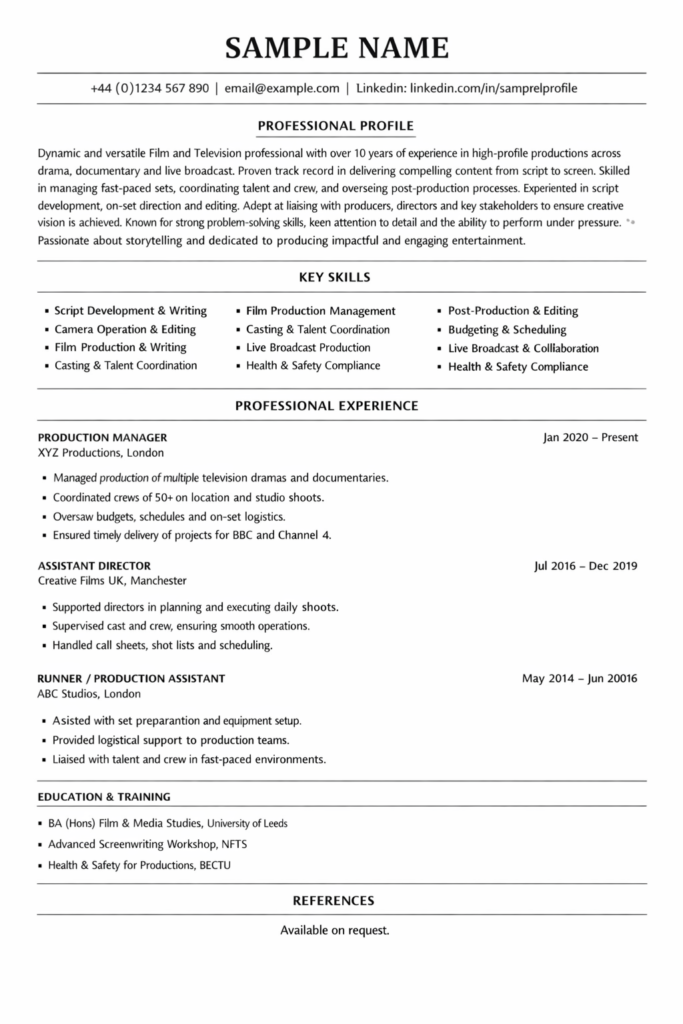
Start with a strong professional profile
Your opening profile is prime space. This short paragraph at the top of your Film and Television CV should position you clearly within the industry. Are you a TV production professional with experience in live broadcast and factual programming. Are you a creative screenwriter with commissioned scripts and festival recognition. Are you an experienced production assistant with a track record supporting high profile shoots.
Use clear industry keywords such as Film and Television CV, TV production, media professional, broadcast experience, post production expertise and creative storytelling. These phrases are important not only for applicant tracking systems but also for recruiters searching databases for talent.
Keep it focused and confident. Avoid generic statements. Instead, demonstrate credibility with specifics.
Highlight your credits strategically
In Film and Television, credits matter. However, presentation matters just as much. Rather than listing everything chronologically without context, group your experience in a way that showcases progression and relevance.
For actors, include production title, role name, production company and director. For production professionals, outline project title, format such as drama, documentary or entertainment, your role and key responsibilities. If you worked in broadcast television, mention the channel or platform.
If you are earlier in your career, do not underestimate roles such as runner or production assistant. Many hiring managers know that these positions require stamina, organisation and teamwork. Present them as evidence of your work ethic and industry exposure.
Showcase key skills for the media industry
A strong media CV balances creative talent with practical skills. In Film and Television, employers look for reliability as much as creativity.
Include technical skills such as editing software, camera operation, script development, budgeting, scheduling and post production workflows. If you work in television production, mention compliance, health and safety knowledge and experience liaising with talent or contributors.
Soft skills are equally important. Communication, problem solving, resilience under pressure and collaboration are highly valued across film and television production environments. Be specific. Instead of stating excellent communication skills, explain how you coordinated between departments on a multi camera shoot or supported a producer during a tight turnaround.
Training and professional development
The Film and Television industry respects continuous development. Include relevant training, workshops, drama school education or media degrees. If you have attended masterclasses or industry recognised courses, add them.
For emerging professionals seeking a Film and Television CV template UK employers respect, remember that quality presentation reflects industry standards. Formatting should be clean, easy to read and no longer than two pages for most roles. Actors may use a one page performance CV alongside a showreel.
Include your showreel and portfolio
In this sector, evidence is everything. Always include a link to your showreel, portfolio or IMDb profile where relevant. Make sure links are professional and up to date. A broken link can cost you an opportunity.
Your LinkedIn profile should also align with your CV. Increasingly, producers and hiring managers will search for you online before making contact. Consistency across your Film and Television CV and LinkedIn profile optimisation is essential.
Tailor your CV for each opportunity
One of the most common mistakes I see is sending the same CV to every production company. The Film and Television industry is diverse. A factual documentary producer will value different experience compared to a high end drama production team.
Study the job description carefully. Mirror the language used in the advert. If they emphasise development research, highlight your research achievements. If they need live broadcast experience, bring that to the forefront.
This tailored approach dramatically improves your success rate and ensures your TV production CV speaks directly to decision makers.
Professional presentation makes the difference
A creative CV does not mean an overly designed document. In the UK market, clarity and professionalism win over gimmicks. Choose a clean layout, consistent font and logical structure. Spelling and grammar must be flawless. In an industry built on scripts and communication, errors undermine credibility.
As someone who has provided CV writing services London professionals trust for decades, I can assure you that small refinements often produce significant results.
Your next step
If you are serious about progressing in Film and Television, do not leave your CV to chance. A compelling Film and Television CV example can guide you, but personalised expertise can transform your prospects.
I would be delighted to help you present your experience with authority and confidence. Book an appointment with me, Jerry Frempong, or one of CVLondon expert CV writers to have your CV and LinkedIn profile professionally improved.
Take that decisive step today and invest in your future in Film and Television.
Book your appointment here
https://www.cvlondon.net/book-an-appointment/
Film and Television CV Sample