How to write a Game Development CV that gets you hired
After more than twenty five years as a UK career coach, I can tell you with confidence that the game development industry rewards clarity, creativity and commercial awareness. A strong Game Development CV is not just a list of programming languages and projects. It is a strategic marketing document that demonstrates your technical expertise, game design insight and ability to deliver results in a competitive digital environment.
Start with a powerful professional profile
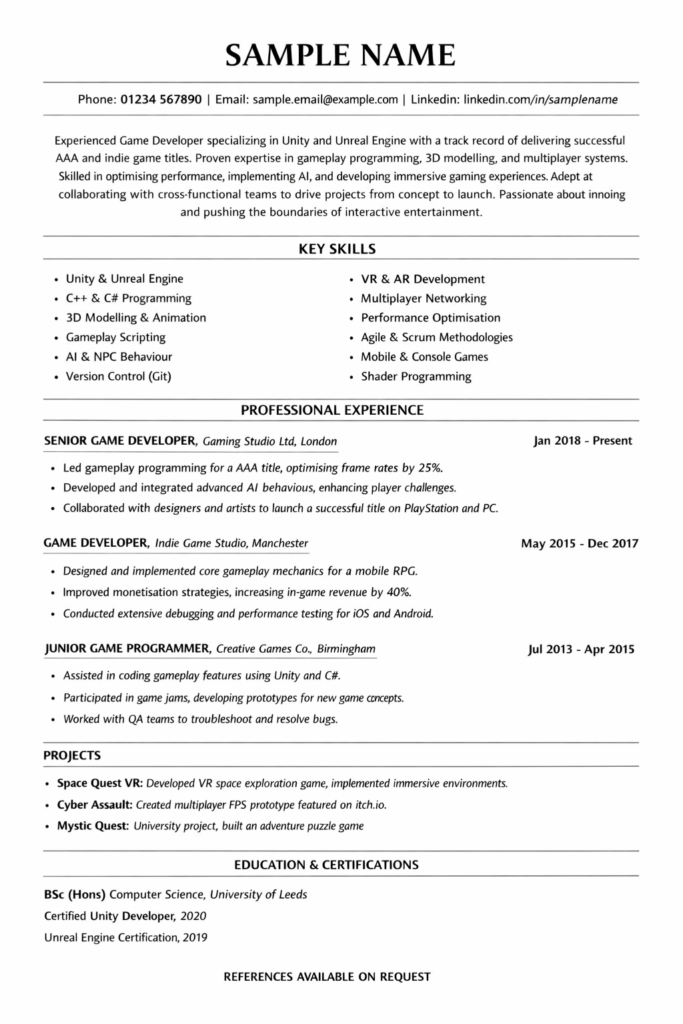
Your professional profile is prime real estate. In three to four concise sentences, communicate your specialism, years of experience and the value you bring. Use strong SEO keywords naturally within the text such as game developer, Unity developer, Unreal Engine, gameplay programmer, C plus plus, C sharp, 3D modelling, game design, mobile games and console development.
For example, you might describe yourself as an experienced game developer with commercial experience in Unity and Unreal Engine, specialising in gameplay systems and performance optimisation. This immediately positions you within the game development sector and improves visibility if your CV is searched in an applicant tracking system.
Highlight technical skills strategically
A well structured technical skills section is essential in any Game Development CV sample. Recruiters and hiring managers scan quickly, so make this section easy to digest. Group skills under clear categories such as programming languages, game engines, tools and software, and platforms.
Include relevant keywords like Unity, Unreal Engine, C sharp, C plus plus, Blender, Maya, Git, artificial intelligence, virtual reality, augmented reality and multiplayer networking if they genuinely reflect your experience. Avoid exaggeration. Employers in game development can quickly identify inflated claims during technical interviews.
Showcase professional experience with impact
Your professional experience section should demonstrate more than duties. Focus on achievements and outcomes. Instead of stating that you were responsible for gameplay programming, explain how you improved frame rate performance by a measurable percentage or contributed to a successful game launch on Steam, PlayStation or mobile platforms.
Quantify results wherever possible. Mention user engagement improvements, download figures, revenue impact or successful collaboration within cross functional teams. This transforms your Game Development CV from a task list into a compelling success story.
If you are early in your career, include internships, university projects or game jams. The game development industry values practical demonstration of skills. Employers care about what you can build.
Include a dedicated projects section
In many Game Development CV examples I review, the strongest candidates include a projects section. This is particularly powerful for gameplay programmers, technical artists and indie developers.
Briefly describe each project, the engine used, your specific contribution and the outcome. If the project is live, reference your online portfolio or GitHub repository. Make it easy for employers to see your code quality, design thinking and creativity in action.
Education and professional development
For graduates, your degree in computer science, game design or software engineering will carry weight. Include relevant modules such as graphics programming, artificial intelligence or physics simulation. For experienced professionals, keep education concise and focus more heavily on commercial achievements.
Certifications in Unity or Unreal Engine can strengthen your Game Development CV template, especially if you are transitioning into the sector. Continuous learning signals passion and commitment, qualities highly valued in this fast evolving industry.
Demonstrate soft skills and collaboration
Game development is rarely a solo endeavour. Studios look for professionals who communicate effectively, respond well to feedback and thrive in collaborative environments. Highlight experience working with designers, artists, producers and QA teams.
Mention agile methodologies, sprint planning or version control workflows if applicable. Strong communication and teamwork skills differentiate you from technically competent but isolated candidates.
Optimise formatting and structure
A clear layout is essential. Keep your CV to two pages where possible. Use consistent headings, logical structure and professional language. Avoid dense blocks of text. Ensure there are no spelling or grammar errors. Attention to detail reflects your approach to coding and development.
Tailor your CV for each application. A mobile games studio may prioritise optimisation and monetisation experience, while a console developer may value performance engineering and complex gameplay systems.
Create a compelling online presence
In today digital market, your CV should align with your LinkedIn profile and online portfolio. Recruiters often review all three before making interview decisions. Ensure consistency in job titles, dates and achievements. Use LinkedIn to reinforce your expertise in game development, game design and software engineering.
Final thoughts from Jerry Frempong
Writing a successful Game Development CV is about clarity, credibility and commercial impact. It is about presenting yourself as a problem solver, innovator and collaborative professional who can contribute to successful game releases.
If you are serious about securing interviews in the game development industry, do not leave your CV to chance. A professionally written CV can dramatically increase response rates and position you ahead of equally qualified competitors.
I would be delighted to help you refine your CV and LinkedIn profile to reflect your true value. Book an appointment with me, Jerry Frempong, or one of CVLondon expert CV writers today and take the next confident step in your career.
Your future in game development deserves nothing less than excellence.
Game Development CV Sample