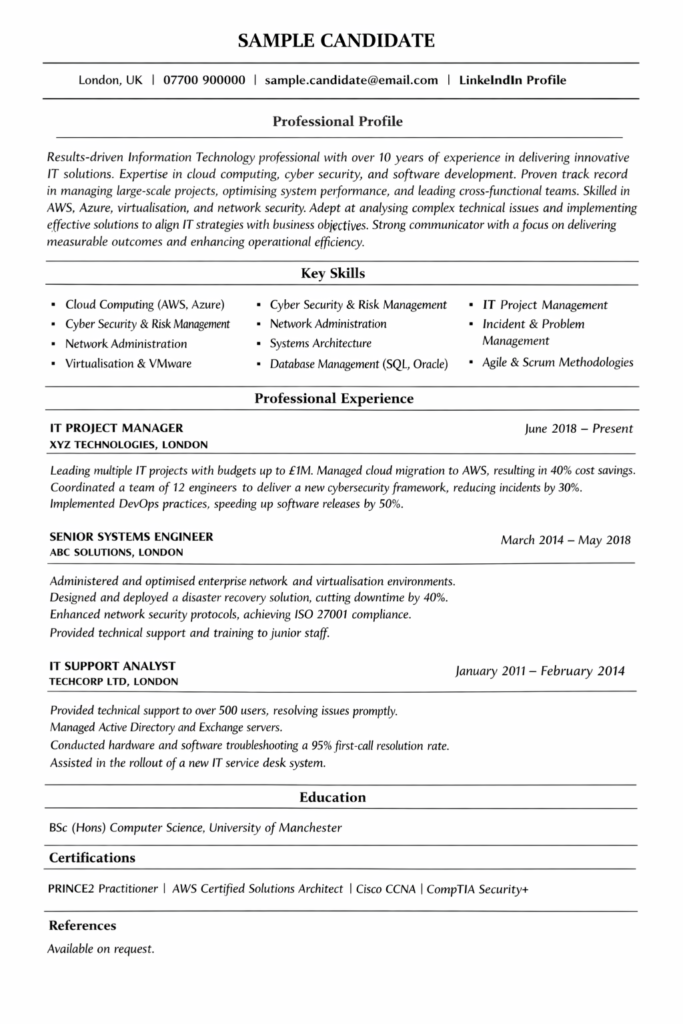
Writing a compelling Information Technology CV is one of the most important steps you will take in advancing your career. After more than 25 years as a UK based career coach, I can confidently say that a well structured IT CV opens doors faster than almost anything else. The technology sector is competitive, but it is also full of opportunity for professionals who present their skills clearly and strategically.
The first principle of a strong Information Technology CV is clarity. Hiring managers in IT, whether recruiting for software development, cyber security, cloud computing, data analysis, IT support or infrastructure roles, want to see quickly what you specialise in. Your professional profile at the top of your IT CV should summarise your years of experience, key technical skills, and the value you bring. This is not the place for vague statements. Be specific about your expertise such as network engineer, systems administrator, DevOps engineer, solutions architect or project management professional.
Next, focus on your technical skills section. In the UK jobs market, recruiters often scan for keywords before reading in depth. Your IT CV should therefore include relevant technologies, programming languages, frameworks, operating systems, databases and tools. If you work in cloud computing, mention platforms such as AWS, Azure or Google Cloud. If your background is in software development, include languages like Java, Python or C sharp and methodologies such as agile. For infrastructure or cyber security professionals, list firewalls, virtualisation technologies, security standards and compliance frameworks. This keyword rich approach ensures your Information Technology CV performs well in applicant tracking systems and aligns with modern recruitment practices.
However, technical skills alone are not enough. A powerful IT CV example always demonstrates impact. Employers want results. Instead of writing that you were responsible for maintaining systems, explain how you improved system uptime to 99.9 percent or reduced incident response times by 30 percent. If you led a project management initiative, quantify budgets, timelines and team sizes. If you implemented a new data analysis solution, describe how it improved reporting accuracy or supported strategic decision making. Numbers create credibility and show that you understand business value, not just technology.
Structure is equally important in your Information Technology CV template. Present your career history in reverse chronological order. For each role, include your job title, organisation name, and dates of employment. Follow this with a concise overview and then bullet points outlining achievements. Keep sentences sharp and focused. Avoid long paragraphs that hide your strengths. A clean, professional layout reflects the precision expected in IT roles.
Certifications and professional development deserve their own section. In the fast evolving world of Information Technology, continuous learning is essential. Include certifications such as ITIL, Prince2, Microsoft, Cisco, CompTIA, AWS or cyber security accreditations. If you have completed specialist training in agile, DevOps practices or advanced data analysis, highlight this clearly. Employers value professionals who invest in keeping their knowledge current.
Do not overlook soft skills. Many candidates underestimate how important communication, stakeholder management and leadership are in technology roles. Whether you are in IT support, systems administration or enterprise architecture, you must translate technical concepts into language that non technical colleagues understand. Demonstrating collaboration, mentoring or cross functional teamwork will strengthen your IT CV significantly.
Your education section should be clear and relevant. List degrees, particularly in computer science, Information Technology or related fields. If you are earlier in your career, you can provide slightly more detail about academic projects that demonstrate practical skills. For experienced professionals, keep this section concise and allow your career achievements to take centre stage.
Finally, ensure your LinkedIn profile aligns with your Information Technology CV. Recruiters routinely compare both. Consistency in job titles, dates and achievements builds trust. An optimised LinkedIn profile using the same SEO keywords such as IT CV example, Information Technology CV template, cloud computing specialist, cyber security analyst or software development manager can significantly increase your visibility.
Before submitting your IT CV, review it carefully. Check spelling, formatting and consistency. Ask yourself whether every line adds value. If something does not strengthen your application, remove it. A focused and confident presentation will always outperform a generic document.
The technology sector in the UK continues to grow, and talented professionals are in demand. With a strategic and well written Information Technology CV, you position yourself not just as a candidate, but as a solution to an employer’s challenges. I have seen countless clients transform their career trajectory simply by refining how they present their expertise.
If you are serious about securing interviews and advancing your career in Information Technology, I warmly invite you to take the next step. Book a personal consultation with me, Jerry Frempong, or one of CVLondon’s expert CV writers. We will work with you to craft a compelling IT CV and optimise your LinkedIn profile so you stand out with confidence in the UK jobs market.
Secure your appointment today at https://www.cvlondon.net/book-an-appointment/ and let us help you present your professional story at the level it truly deserves. Your next opportunity could be closer than you think.
Information Technology CV Sample