
how to write an insurance cv that stands out
After more than 25 years helping professionals across the UK insurance market, I can confidently say that a well-written insurance CV is one of the most powerful tools in your career toolkit. Whether you work in underwriting, claims, broking, risk, compliance, actuarial, or insurance operations, your CV must clearly demonstrate commercial awareness, technical expertise and measurable impact. When done well, it opens doors. When done poorly, it quietly closes them.
start with clarity and focus
An insurance CV should never be vague. Recruiters and hiring managers in insurance are busy, detail-oriented and commercially minded. From the first glance, your CV must communicate exactly what you do, the type of insurance environment you work in and the value you bring. This means being clear about whether your background sits in general insurance, life and pensions, Lloyd’s market, reinsurance, commercial lines or personal lines.
Open with a concise professional profile. Think of this as your personal positioning statement. In a few lines, summarise your role, years of experience, areas of specialism and the results you are known for. This section is essential for keyword optimisation and helps ensure your insurance CV performs well with applicant tracking systems.
structure your insurance cv for easy reading
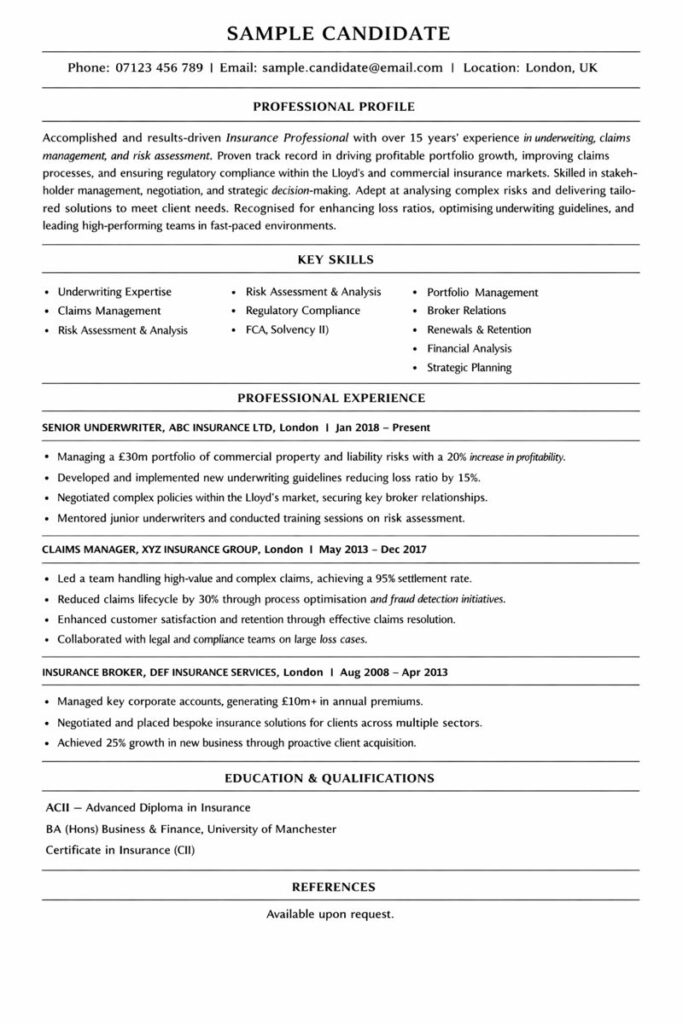
A strong insurance CV follows a logical, clean structure. Start with your professional profile, followed by key skills, professional experience, qualifications and education. Recruiters typically scan before they read, so layout matters. Use clear spacing, consistent formatting and bullet points that are achievement-led rather than task-focused.
In insurance, credibility matters. Listing technical competencies such as underwriting authority, claims handling limits, policy wordings, regulatory frameworks, FCA knowledge, Solvency II, IFRS 17 or risk modelling tools helps establish confidence quickly. Always tailor this section to the role you are targeting rather than listing everything you have ever touched.
write impact-driven experience
This is where most insurance professionals undersell themselves. Your CV should not read like a job description. Instead, it should tell a story of contribution, improvement and commercial value. For each role, briefly set the context and then focus on outcomes.
For example, rather than saying you handled a portfolio of commercial risks, explain the size of the book, premium value, loss ratio improvement or retention achieved. Claims professionals should highlight settlement values, cycle time reductions, fraud detection or customer satisfaction improvements. Brokers should demonstrate revenue growth, new client acquisition and cross-selling success.
Quantified results are gold in an insurance CV. Numbers build trust and differentiate you instantly.
showcase qualifications and continuous development
Insurance is a profession built on technical credibility. Professional qualifications such as CII, ACII, Dip CII, FCII, actuarial exams or compliance certifications should be clearly presented. Include ongoing CPD to show you are committed to staying current in a constantly evolving regulatory and market environment.
If you are earlier in your insurance career, do not worry. Emphasise training programmes, rotations, mentoring and exposure to different classes of business. Employers value potential as much as experience when it is clearly articulated.
optimise for insurance recruitment and seo
An effective insurance CV must balance human readability with search optimisation. Many insurance roles are filtered using applicant tracking systems, so relevant keywords matter. Terms such as insurance professional, underwriting experience, claims management, insurance compliance, risk assessment, broking, commercial insurance and regulatory knowledge should appear naturally throughout your CV.
Avoid copying job adverts word for word. Instead, reflect the language of the sector while maintaining authenticity. A CV that sounds genuinely you will always outperform one that sounds generic.
tone, confidence and authenticity
Your CV should feel confident, not arrogant. Optimistic, not exaggerated. As a career coach, I always encourage candidates to own their achievements while remaining grounded. Insurance is a relationship-driven industry built on trust, and your CV should reflect that professionalism.
Keep language positive and forward-looking. Show progression, learning and adaptability. Employers want to see that you can navigate complexity, manage risk and add value in changing market conditions.
Insurance CV Sample
final thoughts and next steps
Writing a high-performing insurance CV is both an art and a discipline. It requires clarity, strategy and a deep understanding of what the insurance market values. When your CV aligns your expertise with the needs of employers, interviews follow naturally.
If you would like expert support, I would be delighted to help. Whether you are aiming for promotion, transitioning within insurance, or targeting a more senior role, a professionally written CV and optimised LinkedIn profile can be career changing.
Book an appointment to have your CV and LinkedIn profile transformed with me, Jerry Frempong, or one of CVLondon’s expert CV writers. Together, we will position you for the opportunities you deserve.
https://www.cvlondon.net/book-an-appointment/