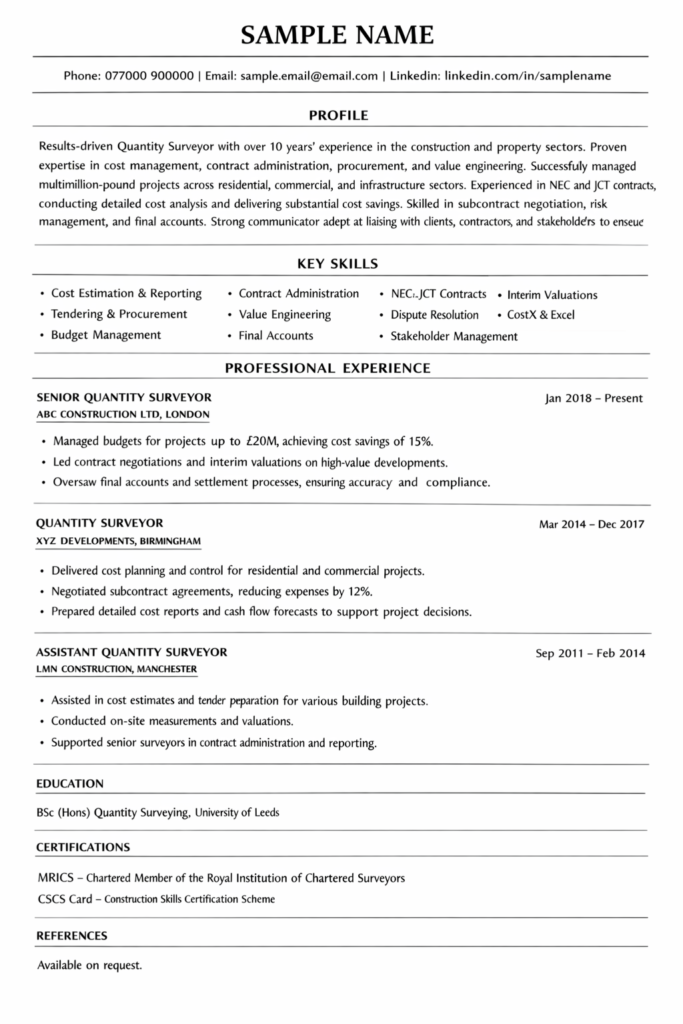
If you are looking to write a compelling Quantity Surveying CV, you are already taking a positive step towards shaping your next career move. As a UK based career coach with over 25 years of experience supporting construction professionals, I can assure you that a well crafted CV is one of the most powerful tools in your professional toolkit. The construction and property sector is competitive, yet full of opportunity for skilled Quantity Surveyors who present themselves effectively.
Start with a clear professional profile
Your professional profile is your introduction. In three to five lines, summarise your experience, sector exposure and key strengths. Whether you are a Chartered Quantity Surveyor, Assistant Quantity Surveyor or Commercial Manager, your profile should immediately reference core competencies such as cost management, contract administration, procurement strategy, budget control and risk management. Include your years of experience, the value of projects you have handled and the sectors you have worked in such as residential, commercial, infrastructure or fit out.
This section must be rich in relevant keywords including Quantity Surveying, cost planning, tendering, NEC contracts, JCT contracts, value engineering and project lifecycle management. These are essential for applicant tracking systems used by construction recruiters and major contractors across the UK.
Highlight measurable achievements
A strong Quantity Surveying CV does more than list duties. It demonstrates commercial impact. Employers want to see evidence of cost savings, profit improvement and successful project delivery. For example, you might state that you managed project budgets exceeding several million pounds, reduced procurement costs by a specific percentage or successfully negotiated subcontractor agreements that improved margins.
Use numbers wherever possible. Quantified results build credibility and position you as a commercially astute construction professional. This is particularly important if you are applying for roles with leading contractors, consultancies or property developers.
Detail your core competencies
Create a key skills section that showcases your technical and commercial expertise. Include cost estimation, cost reporting, interim valuations, final accounts, contract negotiation, change control, dispute resolution and supply chain management. If you are proficient in software such as CostX, Bluebeam, Excel or construction project management systems, include these as well.
For senior professionals, emphasise leadership, stakeholder management, client liaison and team supervision. For graduate or assistant level candidates, highlight training, site exposure and academic achievements in Quantity Surveying or Commercial Management.
Structure your career history effectively
Your employment history should be presented in reverse chronological order. For each role, include your job title, employer name and dates of employment. Under each position, provide a concise overview of your responsibilities followed by achievement focused bullet points.
Be clear about the types of projects you worked on, the contract forms you administered and the scale of budgets you controlled. Mention collaboration with project managers, site managers, architects and engineers. Demonstrate your understanding of the full construction lifecycle from pre construction through to final account settlement.
Showcase your qualifications and professional development
The UK construction industry places high value on professional accreditation. If you are a member of the Royal Institution of Chartered Surveyors, clearly state your MRICS or FRICS status. Include your degree in Quantity Surveying, Construction Management or a related discipline, along with any relevant certifications.
Continuous professional development is highly regarded. Mention courses in contract law, health and safety, risk management or commercial strategy. This shows commitment to maintaining industry knowledge and professional standards.
Tailor your CV for each application
One of the most important aspects of writing a Quantity Surveying CV is tailoring it for the specific role. Study the job description carefully and reflect the language used by the employer. If the role emphasises NEC contract experience, highlight your expertise in that area. If it focuses on residential development, ensure your relevant projects are prominent.
Customisation significantly increases your chances of passing applicant tracking systems and securing interviews with construction recruiters and hiring managers.
Keep presentation professional and concise
Aim for a clear layout with logical sections and consistent formatting. Two pages is ideal for most Quantity Surveyors, although senior professionals may require slightly more detail. Avoid unnecessary graphics or excessive wording. Clarity, professionalism and relevance are key.
Remember that your CV is a marketing document. It should position you as a commercially aware, detail oriented and results driven construction professional ready to add value from day one.
Take the next step with expert support
After working with thousands of construction professionals across the UK, I know that even experienced Quantity Surveyors often underestimate their value. A professionally written CV and optimised LinkedIn profile can dramatically increase interview invitations and open doors to senior commercial roles.
If you would like personalised guidance and a CV that truly reflects your expertise in Quantity Surveying, cost management and commercial leadership, I warmly invite you to book an appointment with me or one of CVLondon’s expert CV writers. Let us work together to elevate your career prospects and secure the opportunities you deserve.
Book your consultation today at https://www.cvlondon.net/book-an-appointment/ and take confident action towards your next career success.
Quantity Surveying CV Sample