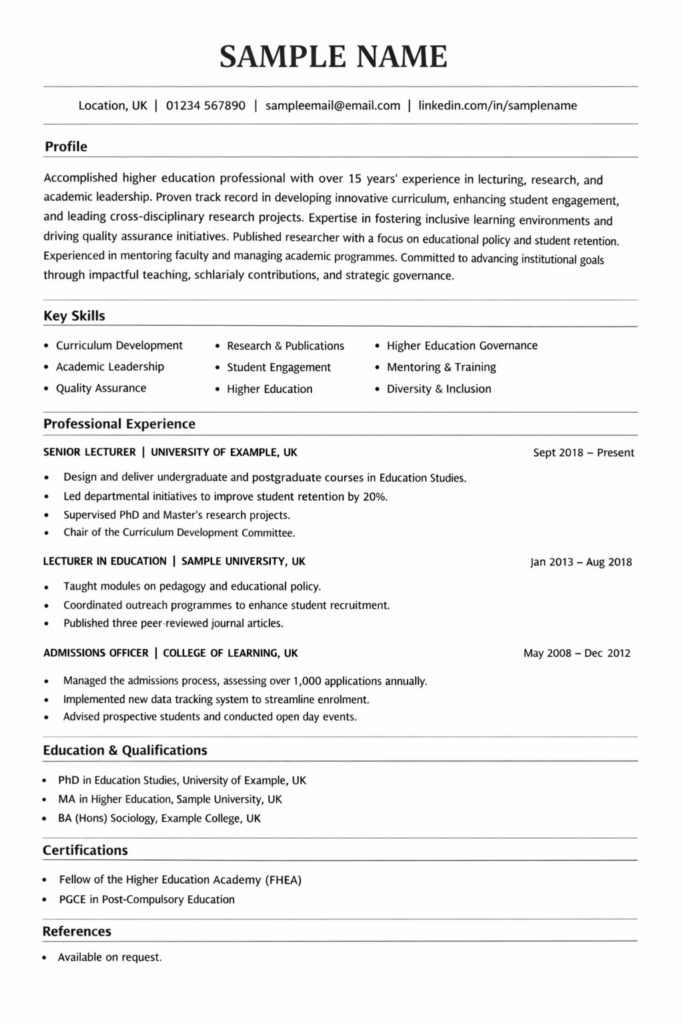
If you are aiming to build a successful career within universities and colleges, your CV must reflect academic excellence, professional credibility, and measurable impact. After more than twenty five years as a UK based career coach, I have supported lecturers, researchers, administrators, admissions professionals, and senior academic leaders in securing rewarding roles across higher education. Writing a compelling Universities and Colleges CV is not about listing responsibilities. It is about demonstrating value, influence, and contribution to education.
Understanding the purpose of a Universities and Colleges CV
A Universities and Colleges CV differs significantly from a corporate CV. Whether you are applying for a lecturer role, academic advisor position, registrar post, or senior leadership opportunity, your CV must align with the expectations of higher education recruitment panels. Universities seek evidence of teaching excellence, research output, student engagement, academic leadership, governance awareness, and commitment to diversity and inclusion.
Your CV should clearly position you within the higher education sector. It must showcase subject expertise, professional development, research publications if relevant, committee involvement, and impact on student outcomes. Clarity, structure, and relevance are essential.
Start with a strong professional profile
Your professional profile is your first opportunity to make a powerful impression. In three to five concise sentences, summarise your academic background, key achievements, and career focus within universities and colleges. This section should include essential keywords such as higher education professional, university lecturer, student engagement, academic leadership, research impact, curriculum development, quality assurance, and widening participation.
For example, you might highlight your years of teaching experience, research specialism, leadership within academic committees, or contribution to student retention initiatives. Keep it focused and aligned with the specific role you are targeting.
Highlight your academic qualifications clearly
In the universities and colleges sector, qualifications carry significant weight. Present your academic background prominently, especially if you hold a postgraduate degree or doctorate. Include your degree title, institution, and year of completion. If your research is relevant, briefly reference your dissertation or thesis topic.
Professional certifications such as Fellowship of the Higher Education Academy, teaching qualifications, or leadership programmes should also be included. These credentials demonstrate commitment to professional development within higher education.
Structure your employment history strategically
Your employment history should not simply describe your duties. Instead, demonstrate impact. For each role, include your job title, institution, and dates of employment. Then outline your achievements using evidence based statements.
For example, rather than stating that you delivered lectures, explain how you designed innovative curriculum content that improved student satisfaction scores. Instead of saying you supported students, highlight measurable improvements in progression rates or graduate outcomes.
Use action focused language and integrate keywords such as academic programme management, student experience, research supervision, stakeholder engagement, compliance, governance, and quality enhancement. These are critical for passing applicant tracking systems and resonating with university hiring panels.
Include research, publications, and conferences if relevant
For academic roles, a dedicated section for research is essential. List peer reviewed publications, conference presentations, funded research projects, and collaborations. This enhances your academic credibility and demonstrates contribution to knowledge within your discipline.
If you have secured research grants or led cross institutional initiatives, make that clear. Universities value candidates who bring funding, partnerships, and reputation.
Demonstrate leadership and committee involvement
Universities and colleges operate through structured governance frameworks. Highlight involvement in academic boards, curriculum committees, equality and diversity initiatives, or quality assurance panels. This signals that you understand institutional processes and can contribute beyond teaching.
Leadership experience, whether formal or informal, should be emphasised. This could include mentoring junior lecturers, leading programme reviews, managing admissions processes, or overseeing student services functions.
Showcase transferable skills for professional services roles
If you are applying for non academic positions within universities and colleges, such as admissions, registry, student support, or operations, focus on skills including policy implementation, compliance, data analysis, stakeholder communication, and project management.
Quantify achievements wherever possible. For instance, improved application processing times, enhanced student satisfaction metrics, or delivered successful outreach campaigns. Higher education institutions appreciate evidence based performance.
Tailor your Universities and Colleges CV for each application
Every university and college has its own mission, values, and strategic priorities. Carefully review the job description and person specification. Align your experience with the competencies outlined. Use their language where appropriate, particularly around themes such as student centred learning, inclusivity, global engagement, research excellence, and community impact.
A tailored Universities and Colleges CV consistently outperforms a generic one.
Keep formatting professional and clear
Use a clean, professional layout with clear headings and consistent spacing. Academic CVs may extend beyond two pages, particularly for research focused roles, but ensure everything included is relevant and adds value.
Proofread carefully. In higher education, attention to detail is non negotiable. A single spelling error can undermine credibility.
Final thoughts from Jerry Frempong
Writing a Universities and Colleges CV is about presenting your academic journey with confidence, clarity, and purpose. You are not just applying for a job. You are positioning yourself as a contributor to learning, research, and institutional growth.
If you would like expert support in crafting a powerful Universities and Colleges CV that secures interviews, I would be delighted to help. At CVLondon, we specialise in professional CV writing for higher education professionals across the UK and internationally. Let us strengthen your CV and LinkedIn profile so that your expertise truly shines.
Book an appointment today with me, Jerry Frempong, or one of our expert CV writers at CVLondon and take the next step in your academic career. https://www.cvlondon.net/book-an-appointment/
Universities and Colleges CV Sample