How to write a compelling Virtual Reality VR and Augmented Reality AR CV
As someone who has coached professionals across the UK technology sector for more than twenty five years, I can tell you with absolute confidence that the Virtual Reality VR and Augmented Reality AR market is bursting with opportunity. From immersive gaming and metaverse development to healthcare simulation, architecture visualisation and enterprise training platforms, employers are searching for talented VR developers, AR engineers and immersive technology specialists who can demonstrate both technical expertise and commercial impact.
Your CV must position you not simply as a technical professional, but as a forward thinking innovator who understands user experience, real time rendering and the business application of immersive technology.
Start with a powerful professional profile
Your opening profile is prime digital estate. In three to four sentences, clearly state your specialism within Virtual Reality VR and Augmented Reality AR. Mention key skills such as Unity development, Unreal Engine, 3D modelling, C Sharp, C Plus Plus, computer vision, spatial computing, XR development, user experience design and interactive storytelling if relevant.
Recruiters searching for VR jobs and AR developer roles will be scanning for these exact keywords. Integrate them naturally while highlighting your years of experience, industry focus and the value you deliver. For example, you might reference delivering immersive training simulations that reduced onboarding time or developing augmented reality retail applications that increased customer engagement.
Showcase your technical expertise strategically
A strong VR and AR CV should contain a clearly structured technical skills section. Divide it into logical categories such as programming languages, development platforms, 3D tools, hardware and collaboration tools.
Include platforms such as Unity, Unreal Engine, ARKit, ARCore, Vuforia, OpenXR and WebXR where applicable. Mention 3D software like Blender, Maya or 3ds Max. If you have experience with Oculus, HTC Vive, Microsoft HoloLens or other XR hardware, make this visible.
This is not about listing everything you have ever touched. It is about aligning your expertise with the job description. Tailoring your CV for each Virtual Reality or Augmented Reality role is essential in a competitive technology recruitment market.
Demonstrate real world project impact
Employers hiring for immersive technology roles want to see outcomes. Anyone can state that they developed a VR simulation. What makes you stand out is demonstrating measurable impact.
For each role, describe the project scope, your responsibilities and the results. Did your augmented reality mobile application improve customer engagement rates. Did your virtual reality training environment reduce safety incidents. Did you collaborate with cross functional teams including designers, 3D artists and product managers to deliver a product on time and within budget.
Use active language and quantify wherever possible. Words such as delivered, optimised, implemented, designed and engineered create authority and confidence.
Highlight user experience and commercial awareness
One of the most common mistakes I see in VR CV writing is focusing solely on technical execution. Virtual Reality and Augmented Reality are ultimately about user experience and commercial application.
Show that you understand human centred design, usability testing and user journey mapping. If you have worked closely with clients or stakeholders, mention how you translated business requirements into immersive digital experiences. This reassures employers that you are not just a developer, but a strategic contributor.
Include research and innovation credentials
The VR and AR sector evolves rapidly. If you have contributed to research projects, published papers, spoken at industry events or experimented with emerging technologies such as spatial computing, haptic feedback or artificial intelligence integration, include this.
Innovation is highly valued within immersive technology careers. Demonstrating curiosity and continuous learning signals long term potential.
Education and professional development
List your degree in computer science, game development, digital media, software engineering or a related discipline. If you have completed specialist courses in Unity development, XR design or 3D graphics programming, include them.
Certifications and ongoing professional development show commitment. In a sector driven by technological advancement, employers want professionals who continually refine their skills.
Optimise your CV for applicant tracking systems
Many technology employers use applicant tracking systems to screen CVs. This is where strategic keyword usage becomes critical. Ensure phrases such as Virtual Reality developer, Augmented Reality engineer, XR developer, immersive technology specialist, Unity developer, Unreal Engine developer and 3D application development appear naturally within your CV.
Avoid graphics heavy layouts that confuse automated systems. A clean, well structured document with clear headings and consistent formatting is far more effective.
Create a portfolio link that strengthens your application
In the world of VR and AR development, a portfolio is invaluable. Include a link to your online portfolio, GitHub repository or interactive demos. Make sure it is professional, easy to navigate and showcases your strongest work.
Recruiters hiring for metaverse development, gaming studios and immersive experience agencies will often review your portfolio before inviting you to interview.
Keep it concise yet impactful
Your Virtual Reality VR and Augmented Reality AR CV should ideally be two pages. Focus on relevance. Early career professionals can lean into academic projects and internships, while experienced candidates should prioritise commercial achievements and leadership in XR projects.
Clarity, confidence and strategic positioning are everything.
Final thoughts from Jerry Frempong
The immersive technology sector is one of the most exciting and future focused industries in the UK and globally. Whether you are targeting roles in gaming, healthcare technology, architecture visualisation, retail innovation or enterprise simulation, your CV must reflect both technical excellence and visionary thinking.
If you are serious about securing interviews in Virtual Reality VR and Augmented Reality AR, do not leave your CV to chance. A professionally written CV and a fully optimised LinkedIn profile can dramatically increase recruiter engagement and interview invitations.
I would be delighted to help you position yourself at the forefront of this dynamic industry. Book an appointment with me or one of CVLondon expert CV writers today and let us transform your CV and LinkedIn into powerful career marketing tools that open doors.
Secure your consultation here
https://www.cvlondon.net/book an appointment/
Your next opportunity in immersive technology could be just one expertly written CV away. Let us make it happen.
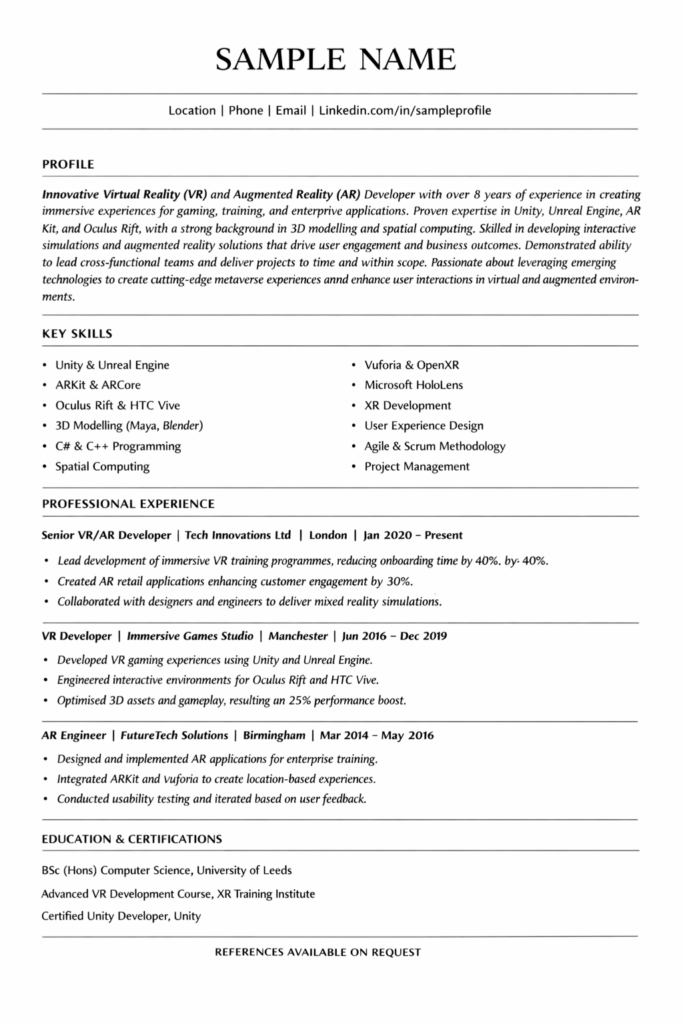
Virtual Reality VR and Augmented Reality AR CV Sample